 The Aura advertising platform is now available to our clients
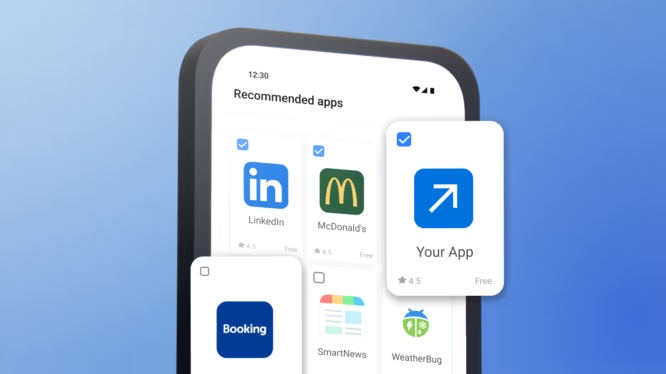
Aura is an advertising platform focused on promoting Android applications through native and interactive ad formats.
The Aura advertising platform is now available to our clients
Aura is an advertising platform focused on promoting Android applications through native and interactive ad formats.
← All posts
Published November 6, 2025
AI tools for mobile Ad creatives: a practical, performance-focused guide
Recent updates in Meta Ads, TikTok Ads, and Google App Campaigns have shifted optimization toward broader targeting and algorithmic delivery. This means that creative has become the primary performance lever.

Industry benchmarks indicate:
-
Up to 70% of mobile ad performance is determined by creative.
-
Advertisers who refresh creatives every 7–14 days reduce CPI by 18–35%.
-
The more creative variations are tested, the faster campaigns scale.
-
AI is now a core production tool for performance teams, not an experimental add-on.
Modern performance teams rely on AI to speed up ideation, generate variations, localize assets, and automate editing. And in 2025, three models dominate the industry: Veo 3, Sora 2, and Nano Banana Pro — accounting for more than 90% of all AI-assisted ad generation workflows.
How AI supports performance creative workflows
| Task | How AI Helps | Practical Outcome |
|---|---|---|
| Ideation and messaging angles | Produces hooks, value props, narrative structure | Prevents creative fatigue |
| High-volume variations | Generates 10–200+ versions per concept | Standardizes scalable testing |
| Localization and segmentation | Adjusts text, voice, UI, context | Raises CVR in new markets |
| Production automation | Montage, subtitles, stylization, re-voicing | Reduces operational load |
Top AI Tools for Mobile Performance Creatives (2025)
High-end video generation
These three models define the current landscape — and drive the majority of mobile-ad production pipelines:
Veo 3 (Google DeepMind)
The most widely adopted model for app-install ad production.
-
Exceptional natural motion
-
Realistic UGC-style scenes
-
Accurate hand-object interaction
-
Great for TikTok-native pacing (1–3 sec hooks)
Sora 2 (OpenAI)
Used heavily for UGC, explainers, and stylized promo content.
-
Cinema-grade scene consistency
-
Fast regeneration cycles for iteration
-
Reliable when producing multi-scene narratives
-
Performs well for gaming, fintech, utilities, and subscription apps
Nano Banana Pro
A lightweight, ultra-fast model used for high-volume iteration.
-
Ideal for 100+ daily variations
-
Great for A/B testing hooks, pacing, angles
-
Optimized for vertical mobile formats
-
Most efficient model for “creative surface area” testing
Together, Veo 3 + Sora 2 + Nano Banana Pro cover over 90% of all AI-generated performance ad workflows in leading mobile-marketing teams.
Video & UGC-style ads
These tools remain heavily used alongside the three primary models:
-
Runway Gen-2 — scene generation, motion & transitions
-
Pika Labs — stylized animation, gaming, comic-style visuals
-
HeyGen — avatar-based localization & multilingual VO
-
CapCut + AI Assist — fast editing, pacing, & format variants
-
ElevenLabs — realistic voiceovers for UGC scripts
Static creatives, Stories, in-app assets
-
Midjourney / Leonardo AI — concept art, visual styles, characters
-
Adobe Firefly — ad layout generation and asset cleanup
-
Figma + Uizard — UI mockups & app demo screens
Copy, hooks, angles, conversion messaging
-
ChatGPT / Claude — angles, scripts, CTA variations
-
Jasper AI — bulk ad copy for iterative testing
How to Structure the Creative Production Process
Step 1 — Define Creative Angles
Example for a fitness app:
-
“5 minutes a day”
-
“No gym needed”
-
“14-day challenge”
-
“Before/After transformation”
-
“Personal story / struggle / result”
Step 2 — Generate Scripts / Storyboards
Prompt template:
Generate 12 UGC video scripts (10–25s) for TikTok/Meta.
Structure: Hook → Problem → Demonstration → Result → CTA.
Goal: drive install for a fitness app.
Step 3 — Produce High-Volume Variants
Important variables to test:
-
First 1–2 seconds (thumb-stop hook)
-
Tone and expression of narrator
-
Background and pacing
-
Offer framing and CTA phrasing
Baseline for stable performance: 20–50 creatives to start.
For scaling: 100–200+ variations.
Common Mistakes
| Mistake | Issue | Correction |
|---|---|---|
| Creating one “perfect” ad | Insufficient signal volume | Test many fast, not one polished |
| No hypothesis tracking | Hard to identify winners | Maintain a structured test sheet |
| Shallow localization | Loss of meaning and persuasion | Adapt cultural context, not only text |
In performance advertising, the winning teams aren’t the ones with the prettiest creatives — they’re the ones who can test hypotheses fast. AI doesn’t replace creative talent; it removes production friction and speeds output by 5–10x. The real competitive advantage comes from iteration speed and the volume of variations the algorithms can learn from.
- Madina Korgoloeva, senior account manager

Conclusion
-
AI-assisted creative production is now a performance requirement, not a novelty.
-
Scale comes from consistent variation and structured testing, not isolated “hero” creatives.
-
The competitive advantage in 2025 is creative iteration speed.

Subscribe and grow with the right intel.
One email a month. Top updates in app marketing, performance analytics, and ad platforms.
By clicking «Subscribe» you agree to Digital Eagle Inc’s
Privacy Policy
and consent to the use of your contact data for monthly newsletter purposes.
Related materials
The Aura advertising platform is now available to our clients
Aura is an advertising platform focused on promoting Android applications through native and interactive ad formats.