
Google Ads Updates Financial and Crypto Ads Certification Process
Google Ads moved crypto and speculative financial product certification into the account. What changed, who needs it and how to prepare your documents.

Advertising Updates
05.07.2026
Get weekly ad updates. No spam

Google is rolling out an updated certification process for advertisers promoting financial services and cryptocurrency-related products. Starting in May 2026, eligible advertisers will be able to submit certification requests directly inside their Google Ads accounts, simplifying compliance and verification workflows for regulated industries.
The new workflow applies to several sensitive advertising categories, including:
The update reflects Google’s continued focus on advertiser verification, financial compliance, and stricter moderation standards across regulated industries.
The new workflow applies to several sensitive advertising categories, including:
- Cryptocurrency exchanges
- Speculative financial products
- Cryptocurrency hardware wallets
The update reflects Google’s continued focus on advertiser verification, financial compliance, and stricter moderation standards across regulated industries.
What Is Changing?
Previously, many financial and crypto advertisers had to complete verification through external forms, third-party partners, or country-specific compliance workflows before launching campaigns.
With the new update, Google is moving more certification management directly into the Google Ads interface.
In practice, advertisers will now be able to manage much more of the certification process directly inside Google Ads:
For agencies and multi-account advertisers, this may significantly reduce operational friction during onboarding and campaign scaling.
However, certification requirements themselves are not being removed. Google will continue reviewing advertisers under strict financial advertising policies depending on GEO, licensing status, and product category.
With the new update, Google is moving more certification management directly into the Google Ads interface.
In practice, advertisers will now be able to manage much more of the certification process directly inside Google Ads:
- certification requests submitted inside Google Ads;
- centralized compliance management;
- easier status tracking;
- simplified document uploads;
- improved visibility into policy approvals and restrictions.
For agencies and multi-account advertisers, this may significantly reduce operational friction during onboarding and campaign scaling.
However, certification requirements themselves are not being removed. Google will continue reviewing advertisers under strict financial advertising policies depending on GEO, licensing status, and product category.
Which Categories Are Impacted?
Cryptocurrency Exchanges
Crypto exchanges promoting:
Depending on the target GEO, Google may request proof of licensing or registration through local regulators, including:
Advertisers should also expect compliance checks related to:
- trading platforms,
- token swaps,
- brokerage services,
- digital asset marketplaces,
- will still require certification in many regions.
Depending on the target GEO, Google may request proof of licensing or registration through local regulators, including:
- MSB (United States),
- FCA (United Kingdom),
- BaFin (Germany),
- VASP registrations,
- or equivalent financial authorities.
Advertisers should also expect compliance checks related to:
- AML/KYC policies,
- consumer protection requirements,
- geographic eligibility,
- financial risk disclosures.
Speculative Financial Products
Google continues maintaining strict restrictions for high-risk financial products, including:
Requirements remain especially strict across:
Certain categories, such as binary options, remain prohibited in many jurisdictions. While the new process makes certification easier to manage, it does not reduce the underlying compliance requirements.
- CFDs,
- leveraged trading,
- forex speculation,
- derivatives,
- spread betting,
- other speculative investment services.
Requirements remain especially strict across:
- European Union,
- United Kingdom,
- Australia,
- Canada.
Certain categories, such as binary options, remain prohibited in many jurisdictions. While the new process makes certification easier to manage, it does not reduce the underlying compliance requirements.
Cryptocurrency Hardware Wallets
Hardware wallet providers may also require verification depending on campaign structure and target regions. This category may include:
Google may request:
- official wallet manufacturers,
- authorized resellers,
- hardware security products for crypto storage.
Google may request:
- proof of company registration,
- reseller authorization,
- product compliance certificates,
- links to official manufacturer resources.
Why This Update Matters
For many fintech and crypto brands, approvals and compliance reviews remain one of the biggest obstacles to scaling paid acquisition.
Delays in verification and compliance reviews can slow:
The updated certification process may help advertisers:
It’s also important to understand that certification alone does not guarantee approval. Moreover, landing pages, creatives, targeting settings, claims, and regional compliance requirements will continue undergoing moderation under Google Ads policies.
Delays in verification and compliance reviews can slow:
- campaign launches,
- scaling,
- international expansion,
- testing new acquisition channels.
The updated certification process may help advertisers:
- launch campaigns faster;
- centralize compliance workflows;
- improve operational efficiency;
- reduce uncertainty during moderation.
It’s also important to understand that certification alone does not guarantee approval. Moreover, landing pages, creatives, targeting settings, claims, and regional compliance requirements will continue undergoing moderation under Google Ads policies.
How to Apply for Certification
⚠️Google has not yet published the final interface rollout for all accounts and GEOs. The workflow below reflects the currently expected process based on Google Ads verification systems and policy updates.
If a request is rejected, advertisers may be allowed to reapply after addressing policy issues or missing documentation.
What Happens Without Certification?
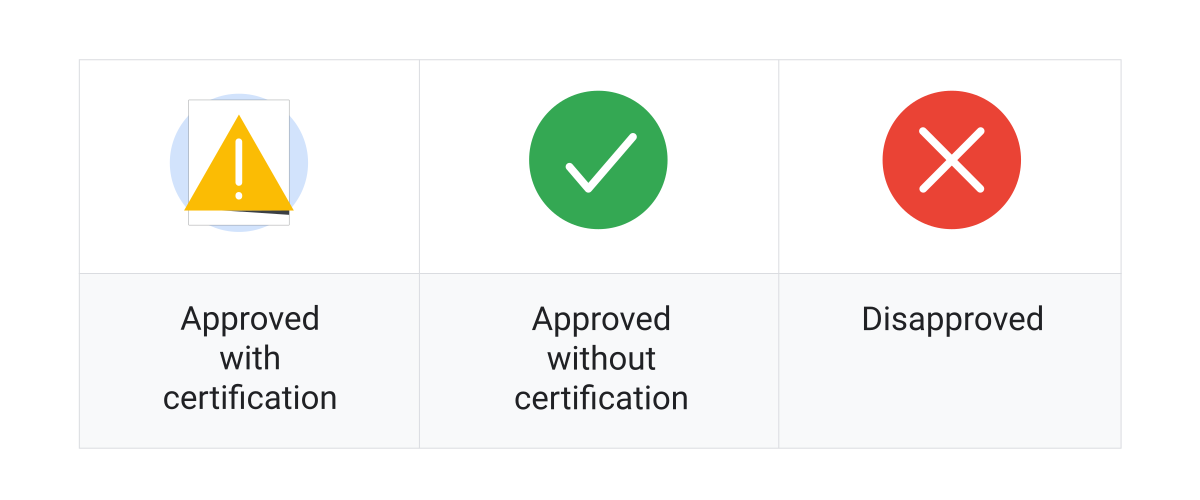
Without valid certification, ads in affected categories may be disapproved by Google Ads moderation systems.
Depending on the target region and product category, advertisers may also encounter:
For many fintech and crypto brands, Google Ads remains one of the primary acquisition channels. As global regulatory pressure around digital finance increases, maintaining policy-compliant advertising infrastructure becomes increasingly important for sustainable growth.
Depending on the target region and product category, advertisers may also encounter:
- restricted campaign delivery;
- additional verification checks;
- country-specific limitations;
- repeated policy reviews;
- higher account risk during moderation.
For many fintech and crypto brands, Google Ads remains one of the primary acquisition channels. As global regulatory pressure around digital finance increases, maintaining policy-compliant advertising infrastructure becomes increasingly important for sustainable growth.
GEO-Specific Compliance Considerations
Compliance requirements for financial and crypto advertising differ substantially across regions, especially in highly regulated markets like the US, UK, and EU.
United States 🇺🇸
Advertisers may require:
Advertisers may require:
- FinCEN registration,
- MSB licensing,
- state-level compliance documentation.
United Kingdom 🇬🇧
Financial promotions are heavily regulated under FCA requirements.
Financial promotions are heavily regulated under FCA requirements.
European Union 🇪🇺
Advertisers should monitor:
Advertisers should monitor:
- MiCA regulation developments,
- local financial licensing,
- consumer protection requirements.
Germany 🇩🇪
BaFin compliance remains especially important for financial advertising approvals.
BaFin compliance remains especially important for financial advertising approvals.
Canada 🇨🇦 & Australia 🇦🇺
Additional verification and disclosure requirements may apply for speculative financial products.
Additional verification and disclosure requirements may apply for speculative financial products.
Summary
The new certification workflow signals a broader shift in how Google approaches financial and crypto advertising compliance. For compliant advertisers in the financial and crypto sectors, the change actually simplifies their work: documents are submitted through a single portal, status is visible in real time, and the history is saved in the account.
However, for businesses that have been putting off legal preparations "until later," May 2026 will be the deadline, after which ads without certification will no longer be displayed. To avoid losing traffic and having campaigns suspended, it’s worth conducting an audit of documents and creatives in advance—preferably 4−6 weeks before the planned campaign launch.
However, for businesses that have been putting off legal preparations "until later," May 2026 will be the deadline, after which ads without certification will no longer be displayed. To avoid losing traffic and having campaigns suspended, it’s worth conducting an audit of documents and creatives in advance—preferably 4−6 weeks before the planned campaign launch.
FAQ
When exactly will the new rules take effect?
Google says the updated workflow is expected to roll out starting in May 2026. Existing certificates will remain valid until they expire.
Do I need to recertify if I’ve already been certified under the old system?
No, not if your certificate is still valid. However, Google recommends switching to the new process during your next renewal to consolidate your account history.
Do the rules apply to remarketing and YouTube ads?
Yes. Certification is required for all Google Ads formats, including Display, Video, Discovery, Performance Max, and Search.
What about DeFi projects and decentralized exchanges?
Certification for DEXs is possible, but it requires an extensive set of documents and often additional verification of the team and legal address. Many DeFi projects fail moderation due to the lack of a centralized jurisdiction.
Google is rolling out an updated certification process for advertisers promoting financial services and cryptocurrency-related products. Starting in May 2026, eligible advertisers will be able to submit certification requests directly inside their Google Ads accounts, simplifying compliance and verification workflows for regulated industries.
The new workflow applies to several sensitive advertising categories, including:
The update reflects Google’s continued focus on advertiser verification, financial compliance, and stricter moderation standards across regulated industries.
The new workflow applies to several sensitive advertising categories, including:
- Cryptocurrency exchanges
- Speculative financial products
- Cryptocurrency hardware wallets
The update reflects Google’s continued focus on advertiser verification, financial compliance, and stricter moderation standards across regulated industries.
What Is Changing?
Previously, many financial and crypto advertisers had to complete verification through external forms, third-party partners, or country-specific compliance workflows before launching campaigns.
With the new update, Google is moving more certification management directly into the Google Ads interface.
In practice, advertisers will now be able to manage much more of the certification process directly inside Google Ads:
For agencies and multi-account advertisers, this may significantly reduce operational friction during onboarding and campaign scaling.
However, certification requirements themselves are not being removed. Google will continue reviewing advertisers under strict financial advertising policies depending on GEO, licensing status, and product category.
With the new update, Google is moving more certification management directly into the Google Ads interface.
In practice, advertisers will now be able to manage much more of the certification process directly inside Google Ads:
- certification requests submitted inside Google Ads;
- centralized compliance management;
- easier status tracking;
- simplified document uploads;
- improved visibility into policy approvals and restrictions.
For agencies and multi-account advertisers, this may significantly reduce operational friction during onboarding and campaign scaling.
However, certification requirements themselves are not being removed. Google will continue reviewing advertisers under strict financial advertising policies depending on GEO, licensing status, and product category.
Which Categories Are Impacted?
Cryptocurrency Exchanges
Crypto exchanges promoting:
Depending on the target GEO, Google may request proof of licensing or registration through local regulators, including:
Advertisers should also expect compliance checks related to:
- trading platforms,
- token swaps,
- brokerage services,
- digital asset marketplaces,
- will still require certification in many regions.
Depending on the target GEO, Google may request proof of licensing or registration through local regulators, including:
- MSB (United States),
- FCA (United Kingdom),
- BaFin (Germany),
- VASP registrations,
- or equivalent financial authorities.
Advertisers should also expect compliance checks related to:
- AML/KYC policies,
- consumer protection requirements,
- geographic eligibility,
- financial risk disclosures.
Speculative Financial Products
Google continues maintaining strict restrictions for high-risk financial products, including:
Requirements remain especially strict across:
Certain categories, such as binary options, remain prohibited in many jurisdictions. While the new process makes certification easier to manage, it does not reduce the underlying compliance requirements.
- CFDs,
- leveraged trading,
- forex speculation,
- derivatives,
- spread betting,
- other speculative investment services.
Requirements remain especially strict across:
- European Union,
- United Kingdom,
- Australia,
- Canada.
Certain categories, such as binary options, remain prohibited in many jurisdictions. While the new process makes certification easier to manage, it does not reduce the underlying compliance requirements.
Cryptocurrency Hardware Wallets
Hardware wallet providers may also require verification depending on campaign structure and target regions. This category may include:
Google may request:
- official wallet manufacturers,
- authorized resellers,
- hardware security products for crypto storage.
Google may request:
- proof of company registration,
- reseller authorization,
- product compliance certificates,
- links to official manufacturer resources.
Why This Update Matters
For many fintech and crypto brands, approvals and compliance reviews remain one of the biggest obstacles to scaling paid acquisition.
Delays in verification and compliance reviews can slow:
The updated certification process may help advertisers:
It’s also important to understand that certification alone does not guarantee approval. Moreover, landing pages, creatives, targeting settings, claims, and regional compliance requirements will continue undergoing moderation under Google Ads policies.
Delays in verification and compliance reviews can slow:
- campaign launches,
- scaling,
- international expansion,
- testing new acquisition channels.
The updated certification process may help advertisers:
- launch campaigns faster;
- centralize compliance workflows;
- improve operational efficiency;
- reduce uncertainty during moderation.
It’s also important to understand that certification alone does not guarantee approval. Moreover, landing pages, creatives, targeting settings, claims, and regional compliance requirements will continue undergoing moderation under Google Ads policies.
How to Apply for Certification
⚠️Google has not yet published the final interface rollout for all accounts and GEOs. The workflow below reflects the currently expected process based on Google Ads verification systems and policy updates.
If a request is rejected, advertisers may be allowed to reapply after addressing policy issues or missing documentation.
What Happens Without Certification?
Without valid certification, ads in affected categories may be disapproved by Google Ads moderation systems.
Depending on the target region and product category, advertisers may also encounter:
For many fintech and crypto brands, Google Ads remains one of the primary acquisition channels. As global regulatory pressure around digital finance increases, maintaining policy-compliant advertising infrastructure becomes increasingly important for sustainable growth.
Depending on the target region and product category, advertisers may also encounter:
- restricted campaign delivery;
- additional verification checks;
- country-specific limitations;
- repeated policy reviews;
- higher account risk during moderation.
For many fintech and crypto brands, Google Ads remains one of the primary acquisition channels. As global regulatory pressure around digital finance increases, maintaining policy-compliant advertising infrastructure becomes increasingly important for sustainable growth.
GEO-Specific Compliance Considerations
Compliance requirements for financial and crypto advertising differ substantially across regions, especially in highly regulated markets like the US, UK, and EU.
United States 🇺🇸
Advertisers may require:
Advertisers may require:
- FinCEN registration,
- MSB licensing,
- state-level compliance documentation.
United Kingdom 🇬🇧
Financial promotions are heavily regulated under FCA requirements.
Financial promotions are heavily regulated under FCA requirements.
European Union 🇪🇺
Advertisers should monitor:
Advertisers should monitor:
- MiCA regulation developments,
- local financial licensing,
- consumer protection requirements.
Germany 🇩🇪
BaFin compliance remains especially important for financial advertising approvals.
BaFin compliance remains especially important for financial advertising approvals.
Canada 🇨🇦 & Australia 🇦🇺
Additional verification and disclosure requirements may apply for speculative financial products.
Additional verification and disclosure requirements may apply for speculative financial products.
Summary
The new certification workflow signals a broader shift in how Google approaches financial and crypto advertising compliance. For compliant advertisers in the financial and crypto sectors, the change actually simplifies their work: documents are submitted through a single portal, status is visible in real time, and the history is saved in the account.
However, for businesses that have been putting off legal preparations "until later," May 2026 will be the deadline, after which ads without certification will no longer be displayed. To avoid losing traffic and having campaigns suspended, it’s worth conducting an audit of documents and creatives in advance—preferably 4−6 weeks before the planned campaign launch.
However, for businesses that have been putting off legal preparations "until later," May 2026 will be the deadline, after which ads without certification will no longer be displayed. To avoid losing traffic and having campaigns suspended, it’s worth conducting an audit of documents and creatives in advance—preferably 4−6 weeks before the planned campaign launch.
FAQ
When exactly will the new rules take effect?
Google says the updated workflow is expected to roll out starting in May 2026. Existing certificates will remain valid until they expire.
Do I need to recertify if I’ve already been certified under the old system?
No, not if your certificate is still valid. However, Google recommends switching to the new process during your next renewal to consolidate your account history.
Do the rules apply to remarketing and YouTube ads?
Yes. Certification is required for all Google Ads formats, including Display, Video, Discovery, Performance Max, and Search.
What about DeFi projects and decentralized exchanges?
Certification for DEXs is possible, but it requires an extensive set of documents and often additional verification of the team and legal address. Many DeFi projects fail moderation due to the lack of a centralized jurisdiction.
You might also like...