
Meta ACE Score for Subscription Apps: What It Is and How to Fix It
What Meta's ACE score is, how it differs from the feedback score, and 7 fixes subscription apps can ship to cut CPMs and protect their Business Manager.

Moderation and Policy
11.05.2026
Get weekly ad updates. No spam

Meta now judges advertisers not solely based on their ads, but by how buyers feel 14−60 days after paying. For subscription-based apps, this is the riskiest window in the whole funnel: the trial has converted, the renewal has hit the card, and the cancel button is hard to find.
The result is a customer experience score that raises your CPMs today and, according to practitioner reports, may soon decide whether Meta keeps working with you at all. This guide separates what Meta has confirmed from what is reported, shows how to estimate your score without a dashboard, and gives a prioritised fix plan with metrics.
Main takeaways:
- Confirmed: Meta surveys people who bought through your ads and rolls the answers into a 0−5 feedback score per Page and per business portfolio. Low scores mean costlier, narrower delivery; if the score drops below 1, the Page can’t advertise.
- Reported: an advertiser-level score (called ACE, later PQ and CES) ranks all advertisers. The bottom 5% may lose credit lines or even their Business Manager.
- Why apps suffer: recurring charges buyers don’t immediately notice, one-tap upsells, missed sign-ins, and buried cancel flows.
- What to do: measure the proxy metrics, fix the leaks described below in order of complaint volume, and track the trade-off against LTV.
- Bonus: almost every fix also moves you closer to FTC, US state, and EU subscription rules.
What the ACE score is: confirmed vs reported
How the survey works, and why subscription apps start behind
Estimate your score without a dashboard
Seven fixes, in the order buyers feel them
The economics: don't fix blind
Regulators want the same fixes
A 30-day plan
Conclusion
FAQ
What the ACE score is: confirmed vs reported
Meta grades customer experience on two levels, and most articles blur the line between them. The first is the feedback score: documented by Meta and visible in your account. The second is ACE: an advertiser-level rating that comes from practitioners and Meta reps talking to large advertisers, and Meta has not published it.
So what is the ACE score?
ACE is usually decoded as Advertising Customer Experience. It is not a public Meta product name. It’s the label practitioners and Meta reps use for an internal, advertiser-level rating of how much your buyers regret buying from you (ECER).
The key difference from the feedback score is the unit of comparison. The feedback score grades one Page on an absolute 0−5 scale. ACE ranks your whole business against every other advertiser, in percentile bands from the bottom 5% to the top 30%. In practice this means that you can hold a decent 3.5 feedback score and still land in a bad band if your vertical’s peers do better.
The main input is the same post-purchase survey. Practitioners report that refund rates, chargebacks and complaint volume feed the picture too (Scoreify). The name changed twice: first ACE, then PQ (page quality), now CES (customer experience score). The mechanics stayed the same.
What ACE does to you depends on the band:
One naming trap: some sources use "ACE" for Asset Compliance Escalation, a separate internal flag that quietly throttles risky assets. The two overlap in symptoms but are different concepts. When this article says ACE, it means the customer experience score.
- Top bands: cheaper CPMs, because Meta prefers your ad when bids are close.
- Middle bands: neutral delivery.
- Bottom 5%: higher CPMs today. In autumn 2026, Meta reps told mobile app companies in Eastern Europe that this band may also lose access to products large advertisers depend on, from the credit line to the Business Manager itself (Bïrch).
One naming trap: some sources use "ACE" for Asset Compliance Escalation, a separate internal flag that quietly throttles risky assets. The two overlap in symptoms but are different concepts. When this article says ACE, it means the customer experience score.
Feedback score vs ACE, side by side
Two more signals point the same way. Meta has publicly said it may impose ad restrictions, financial penalties or disable accounts for businesses with heavy negative feedback (Meta, 2022). And at its 2026 Agency Summit, Meta previewed customer experience insights and benchmarking, with no launch date yet (Rockads).
Don’t confuse it with Opportunity Score, which grades your account setup against Meta’s best practices, or with ad relevance diagnostics (quality, engagement and conversion rankings), which grade individual ads. The customer experience score grades only what happens after the purchase.
How the survey works, and why subscription apps start behind
Between 14 and 60 days after someone buys through your ad, Meta may show them a short survey with your Page logo, asking how satisfied they are. Questions cover whether the product matched the ad, whether support and refunds worked, and whether they’d call the business trustworthy. Only "satisfied" counts as positive; neutral and negative answers both pull the overall score down.
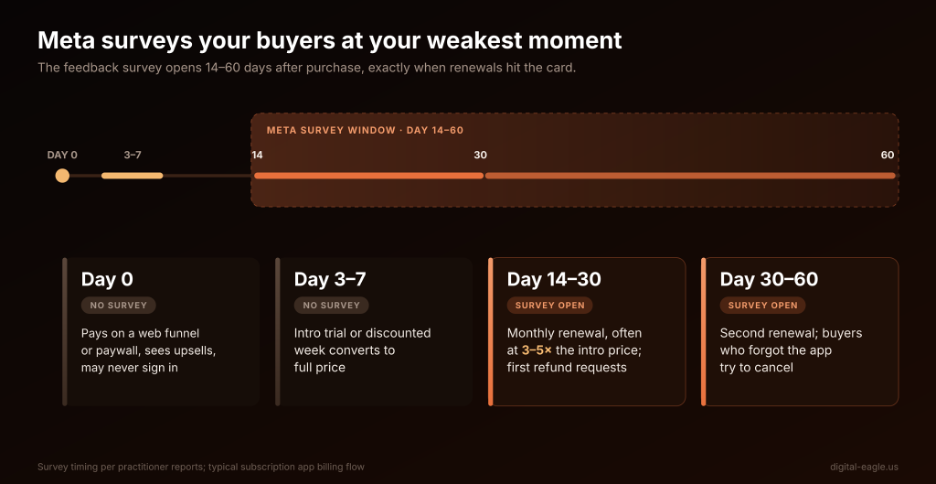
That window is exactly when a subscription buyer meets the unpleasant parts of your model: So a subscription app is graded at its weakest moment. Four patterns make it worse:
- Invisible recurrence: the buyer thought it was a one-off discount.
- Surprise charges: one-tap upsells without a clear "Buy" label.
- Paid but no access: the buyer closed the in-app browser before signing in.
- Hard exit: no visible cancel or refund path, so the buyer goes to the bank, the store, Reddit, and your ad comments.
Estimate your score without a dashboard
ACE dashboard access varies, and a high monthly ad spend does not guarantee visibility. If you have access, start with your documented Page and portfolio feedback scores in Business Suite, then track five proxy metrics for buyers acquired from Meta only, cohorted by purchase week. The thresholds above are practitioner guesstimates, not Meta numbers; your own trend matters more than the absolute value.
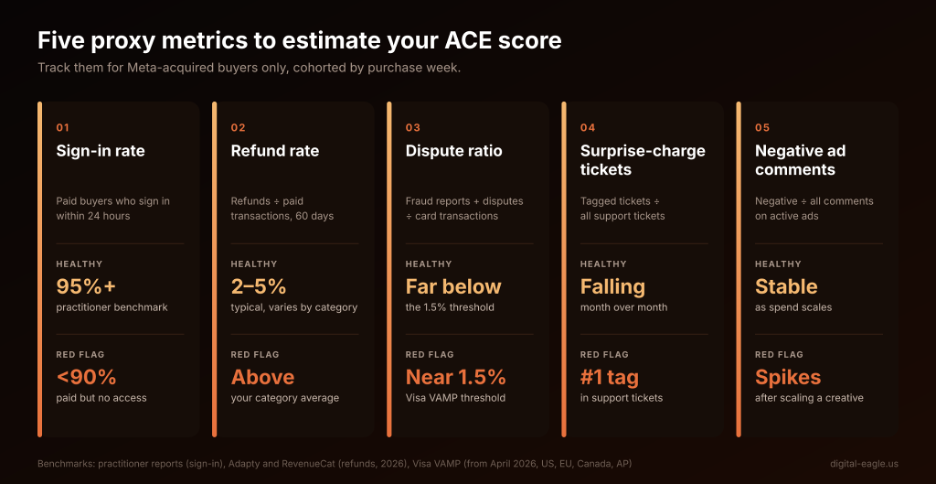
Where the benchmarks come from: the sign-in target is a practitioner benchmark from a UA lead with 10 years in subscription apps. Refund ranges come from Adapty’s 2026 refund benchmarks, and RevenueCat also tracks refund rate as a core benchmark. The 1.5% line is Visa’s VAMP threshold for the US, EU, Canada and Asia-Pacific since April 2026; it applies to your web payments, while App Store and Google Play handle store disputes themselves. None of these are Meta numbers, so your own trend matters more than the absolute value.
Then run a complaint audit. Pull the last 90 days of support tickets, App Store and Google Play reviews, Trustpilot, Reddit threads, and ad comments. Tag each one into a fixed taxonomy:
The ranking of these tags is the order in which they need to be fixed. In most subscription apps, tags 1 and 4 dominate.
Then run a complaint audit. Pull the last 90 days of support tickets, App Store and Google Play reviews, Trustpilot, Reddit threads, and ad comments. Tag each one into a fixed taxonomy:
- Charged unexpectedly (renewal, upsell, trial conversion)
- Paid but couldn’t access
- Product didn’t match the ad
- Couldn’t cancel or get a refund
- Product quality or bugs
The ranking of these tags is the order in which they need to be fixed. In most subscription apps, tags 1 and 4 dominate.
Seven fixes, in the order buyers feel them
Each fix below names the leak, the change, and the metric that proves it worked. None replaces the real lever: a product people keep using. Retention is the best score booster there is.
1. Ads that promise only what the product does
Leak: creatives show features the app doesn’t have, and the funnel amplifies the promise. These buyers are upset with the product right away.
Fix: add a claims review to creative QA. Every feature shown must exist in the version the buyer installs. Cap scaling on any creative whose cohort shows above-average refund or negative-comment rates, however good its CPA.
Metric: refund rate and negative comment rate per creative, not just per campaign.
2. A paywall that says "subscription" out loud
Leak: the buyer thinks they only had to pay once, and at a discount.
Fix: on the paywall and checkout, show the word "subscription", the renewal price, the billing period and the first renewal date, next to the button. Avoid tiny-print renewal terms below the fold.
Metric: share of "unexpected charge" tickets.
Fix: on the paywall and checkout, show the word "subscription", the renewal price, the billing period and the first renewal date, next to the button. Avoid tiny-print renewal terms below the fold.
- Before: "Get your plan, only $ 6.99"
- After: "$ 6.99 for the first month, then $ 29.99/month. Renews automatically on 30 Nov. Cancel anytime in Settings."
Metric: share of "unexpected charge" tickets.
3. Simpler trial and plan structures
Leak: a $ 1−7 seven-day trial that rolls into a monthly or quarterly plan is the single most confusing offer in the category. The buyer can’t predict the next charge.
Fix: sell one plan length with a clearly stated first-period discount (for example, 50% off month one, then the full price). Push 3-month and longer plans: the first renewal then lands after the survey window, and buyers have time to get value first. If you keep trials, send a reminder 2−3 days before conversion.
Metric: refund requests in the first 60 days, by offer.
4. Upsells that look like purchases
Leak: one-tap upsells charge the card from a button that says "Continue"; the skip link is hidden; the buyer faces five screens with no end in sight.
Fix: label every paid button with the price and the word "Buy" or "Add for $X". Make "No thanks" a real, visible button. Cap the sequence at three offers and show a progress bar to the sign-in step.
Metric: upsell refund rate; funnel completion to sign-in.
5. Sign-in after purchase above 95%
Leak: buyers who paid but never reached the product are the angriest group, and they make sure everyone knows it. Web-to-app funnels lose them when the social in-app browser closes.
Fix: pass a token for one-tap sign-in or deep-link install. Send an email within minutes: "We see your payment. Here’s your sign-in link." Follow up at 24 h and 72 h for anyone still not signed in.
Metric: sign-in rate within 24 h; target 95%+.
6. Cancellation in two taps
Leak: no cancel button in the app, a retention maze, or "email support to cancel". Buyers escalate to their bank and to public reviews.
Fix: put "Manage subscription" in the profile tab with a visible cancel button, one optional retention offer, and an on-screen plus email confirmation. For App Store and Google Play billing, deep-link straight to the store’s subscription page.
Metric: cancel-flow completion rate; "couldn't cancel" tickets.
7. Refunds before chargebacks
Leak: a buyer who can’t get a refund files a chargeback and, often, a negative survey answer.
Fix: offer a self-serve refund for first charges and surprise renewals within a short window, approved automatically under a set amount. A fast refund is cheaper than a dispute fee plus a lost customer plus a worse score.
Metric: chargeback rate; refund-to-chargeback ratio.
The economics: don't fix blind
Some fixes cost revenue up front. Clearer pricing lowers paywall conversion; fewer upsells lower day-0 ARPU; easy cancellation lowers involuntary retention. The question is whether lower CPMs, fewer refunds and fewer chargebacks pay that back.
Run each change as a holdout test and judge it on a full-funnel metric, not on paywall conversion alone:
Add the Meta side to the model: track blended CPM for your purchase campaigns before and after. If the score moves, CPM is where you’ll see it first.
Regulators want the same fixes
Meta’s score and subscription law are converging on four requirements: disclose terms clearly, get explicit consent, make cancelling easy, and don’t misrepresent. Fixing for one covers most of the other.
This is an overview, not legal advice; check the rules in your markets with counsel.
A 30-day plan
The fastest wins are copy and flow changes that need no pricing decision. Pricing structure comes last, once you have a test running.
Week 1: measure
☐ Record Page and portfolio feedback scores from Business Suite
☐ Set up the five proxy metrics for Meta-acquired cohorts
☐ Tag 90 days of complaints with the five-tag taxonomy
☐ Add a claims check to creative QA
Week 2: stop the anger
☐ Ship the "here's your sign-in link" email and 24 h / 72 h follow-ups
☐ Add "Manage subscription" with a visible cancel button to the profile tab
☐ Turn on self-serve refunds for first charges
Week 3: make charges expected
☐ Rewrite paywall and checkout copy with renewal price and date
☐ Relabel every paid upsell button with price and "Buy"
☐ Cap upsells at three and add a progress bar
☐ Send a reminder before trial conversion
Week 4: test the economics
☐ Launch a holdout test of one plan length vs trial + rollover
☐ Compare day-30 refund, chargeback and CPM trends to week 1
☐ Pause scaling on creatives with above-average refund cohorts
Conclusion
Meta no longer grades subscription apps only on clicks and conversions. It asks buyers how they feel 14−60 days later, right when renewals land. That answer now shapes your CPMs and, reportedly, whether you keep your credit line and Business Manager.
The fix is not a growth hack. Buyers should understand what they’re paying for, get access the moment they pay, and leave without a fight. Start with sign-in, cancellation and refunds: they cut the angriest feedback fastest. Then clear up pricing and upsells, and test each change against net revenue, not paywall conversion alone.
The score takes one to two months to recover, and campaigns can’t stop in the meantime. Digital Eagle’s agency ad accounts keep spend limits, payments and backup accounts stable while you ship the fixes. They don’t replace the fixes, but they buy you the time to make them.
FAQ
Is ACE the same as the feedback score?
They’re related. The feedback score (0−5) is documented and visible per Page and portfolio. ACE/CES is a reported advertiser-level score that appears to draw on the same surveys plus other signals.
Can I see my ACE score?
Dashboard access varies. In our experience, dashboards have appeared in some high-spend agency Business Managers, but spend alone is not a reliable indicator of access. If you don’t have access, track the feedback scores available in your account and the proxy metrics above.
My app sells through the App Store, not the web. Does this still apply?
Yes, if people buy after clicking your Meta ads and Meta can attribute the purchase. Store billing helps with cancellation, but surprise charges and missed value still drive negative answers.
Can I buy positive feedback?
No. Meta has sued a vendor that sold fake feedback to inflate scores, and it treats that as abuse.
How fast does the score recover?
The documented score updates continuously from recent feedback. Because surveys arrive 14−60 days after purchase, expect a lag of one to two months after a fix ships.
Will moving to an agency ad account fix my ACE score?
No. The score reflects your buyers' experience, so it follows your product and Page. An agency account from a provider like Digital Eagle protects spend limits, payments and account continuity while you fix the funnel.
What if I'm already in the bottom 5%?
Prioritise fixes 5, 6 and 7 first: they cut the angriest feedback fastest. Then fix pricing clarity before you scale spend again.
Meta now judges advertisers not solely based on their ads, but by how buyers feel 14−60 days after paying. For subscription-based apps, this is the riskiest window in the whole funnel: the trial has converted, the renewal has hit the card, and the cancel button is hard to find.
The result is a customer experience score that raises your CPMs today and, according to practitioner reports, may soon decide whether Meta keeps working with you at all. This guide separates what Meta has confirmed from what is reported, shows how to estimate your score without a dashboard, and gives a prioritised fix plan with metrics.
Main takeaways:
- Confirmed: Meta surveys people who bought through your ads and rolls the answers into a 0−5 feedback score per Page and per business portfolio. Low scores mean costlier, narrower delivery; if the score drops below 1, the Page can’t advertise.
- Reported: an advertiser-level score (called ACE, later PQ and CES) ranks all advertisers. The bottom 5% may lose credit lines or even their Business Manager.
- Why apps suffer: recurring charges buyers don’t immediately notice, one-tap upsells, missed sign-ins, and buried cancel flows.
- What to do: measure the proxy metrics, fix the leaks described below in order of complaint volume, and track the trade-off against LTV.
- Bonus: almost every fix also moves you closer to FTC, US state, and EU subscription rules.
What the ACE score is: confirmed vs reported
How the survey works, and why subscription apps start behind
Estimate your score without a dashboard
Seven fixes, in the order buyers feel them
The economics: don't fix blind
Regulators want the same fixes
A 30-day plan
Conclusion
FAQ
What the ACE score is: confirmed vs reported
Meta grades customer experience on two levels, and most articles blur the line between them. The first is the feedback score: documented by Meta and visible in your account. The second is ACE: an advertiser-level rating that comes from practitioners and Meta reps talking to large advertisers, and Meta has not published it.
So what is the ACE score?
ACE is usually decoded as Advertising Customer Experience. It is not a public Meta product name. It’s the label practitioners and Meta reps use for an internal, advertiser-level rating of how much your buyers regret buying from you (ECER).
The key difference from the feedback score is the unit of comparison. The feedback score grades one Page on an absolute 0−5 scale. ACE ranks your whole business against every other advertiser, in percentile bands from the bottom 5% to the top 30%. In practice this means that you can hold a decent 3.5 feedback score and still land in a bad band if your vertical’s peers do better.
The main input is the same post-purchase survey. Practitioners report that refund rates, chargebacks and complaint volume feed the picture too (Scoreify). The name changed twice: first ACE, then PQ (page quality), now CES (customer experience score). The mechanics stayed the same.
What ACE does to you depends on the band:
One naming trap: some sources use "ACE" for Asset Compliance Escalation, a separate internal flag that quietly throttles risky assets. The two overlap in symptoms but are different concepts. When this article says ACE, it means the customer experience score.
- Top bands: cheaper CPMs, because Meta prefers your ad when bids are close.
- Middle bands: neutral delivery.
- Bottom 5%: higher CPMs today. In autumn 2026, Meta reps told mobile app companies in Eastern Europe that this band may also lose access to products large advertisers depend on, from the credit line to the Business Manager itself (Bïrch).
One naming trap: some sources use "ACE" for Asset Compliance Escalation, a separate internal flag that quietly throttles risky assets. The two overlap in symptoms but are different concepts. When this article says ACE, it means the customer experience score.
Feedback score vs ACE, side by side
Two more signals point the same way. Meta has publicly said it may impose ad restrictions, financial penalties or disable accounts for businesses with heavy negative feedback (Meta, 2022). And at its 2026 Agency Summit, Meta previewed customer experience insights and benchmarking, with no launch date yet (Rockads).
Don’t confuse it with Opportunity Score, which grades your account setup against Meta’s best practices, or with ad relevance diagnostics (quality, engagement and conversion rankings), which grade individual ads. The customer experience score grades only what happens after the purchase.
How the survey works, and why subscription apps start behind
Between 14 and 60 days after someone buys through your ad, Meta may show them a short survey with your Page logo, asking how satisfied they are. Questions cover whether the product matched the ad, whether support and refunds worked, and whether they’d call the business trustworthy. Only "satisfied" counts as positive; neutral and negative answers both pull the overall score down.
That window is exactly when a subscription buyer meets the unpleasant parts of your model: So a subscription app is graded at its weakest moment. Four patterns make it worse:
- Invisible recurrence: the buyer thought it was a one-off discount.
- Surprise charges: one-tap upsells without a clear "Buy" label.
- Paid but no access: the buyer closed the in-app browser before signing in.
- Hard exit: no visible cancel or refund path, so the buyer goes to the bank, the store, Reddit, and your ad comments.
Estimate your score without a dashboard
ACE dashboard access varies, and a high monthly ad spend does not guarantee visibility. If you have access, start with your documented Page and portfolio feedback scores in Business Suite, then track five proxy metrics for buyers acquired from Meta only, cohorted by purchase week. The thresholds above are practitioner guesstimates, not Meta numbers; your own trend matters more than the absolute value.
Where the benchmarks come from: the sign-in target is a practitioner benchmark from a UA lead with 10 years in subscription apps. Refund ranges come from Adapty’s 2026 refund benchmarks, and RevenueCat also tracks refund rate as a core benchmark. The 1.5% line is Visa’s VAMP threshold for the US, EU, Canada and Asia-Pacific since April 2026; it applies to your web payments, while App Store and Google Play handle store disputes themselves. None of these are Meta numbers, so your own trend matters more than the absolute value.
Then run a complaint audit. Pull the last 90 days of support tickets, App Store and Google Play reviews, Trustpilot, Reddit threads, and ad comments. Tag each one into a fixed taxonomy:
The ranking of these tags is the order in which they need to be fixed. In most subscription apps, tags 1 and 4 dominate.
Then run a complaint audit. Pull the last 90 days of support tickets, App Store and Google Play reviews, Trustpilot, Reddit threads, and ad comments. Tag each one into a fixed taxonomy:
- Charged unexpectedly (renewal, upsell, trial conversion)
- Paid but couldn’t access
- Product didn’t match the ad
- Couldn’t cancel or get a refund
- Product quality or bugs
The ranking of these tags is the order in which they need to be fixed. In most subscription apps, tags 1 and 4 dominate.
Seven fixes, in the order buyers feel them
Each fix below names the leak, the change, and the metric that proves it worked. None replaces the real lever: a product people keep using. Retention is the best score booster there is.
1. Ads that promise only what the product does
Leak: creatives show features the app doesn’t have, and the funnel amplifies the promise. These buyers are upset with the product right away.
Fix: add a claims review to creative QA. Every feature shown must exist in the version the buyer installs. Cap scaling on any creative whose cohort shows above-average refund or negative-comment rates, however good its CPA.
Metric: refund rate and negative comment rate per creative, not just per campaign.
2. A paywall that says "subscription" out loud
Leak: the buyer thinks they only had to pay once, and at a discount.
Fix: on the paywall and checkout, show the word "subscription", the renewal price, the billing period and the first renewal date, next to the button. Avoid tiny-print renewal terms below the fold.
Metric: share of "unexpected charge" tickets.
Fix: on the paywall and checkout, show the word "subscription", the renewal price, the billing period and the first renewal date, next to the button. Avoid tiny-print renewal terms below the fold.
- Before: "Get your plan, only $ 6.99"
- After: "$ 6.99 for the first month, then $ 29.99/month. Renews automatically on 30 Nov. Cancel anytime in Settings."
Metric: share of "unexpected charge" tickets.
3. Simpler trial and plan structures
Leak: a $ 1−7 seven-day trial that rolls into a monthly or quarterly plan is the single most confusing offer in the category. The buyer can’t predict the next charge.
Fix: sell one plan length with a clearly stated first-period discount (for example, 50% off month one, then the full price). Push 3-month and longer plans: the first renewal then lands after the survey window, and buyers have time to get value first. If you keep trials, send a reminder 2−3 days before conversion.
Metric: refund requests in the first 60 days, by offer.
4. Upsells that look like purchases
Leak: one-tap upsells charge the card from a button that says "Continue"; the skip link is hidden; the buyer faces five screens with no end in sight.
Fix: label every paid button with the price and the word "Buy" or "Add for $X". Make "No thanks" a real, visible button. Cap the sequence at three offers and show a progress bar to the sign-in step.
Metric: upsell refund rate; funnel completion to sign-in.
5. Sign-in after purchase above 95%
Leak: buyers who paid but never reached the product are the angriest group, and they make sure everyone knows it. Web-to-app funnels lose them when the social in-app browser closes.
Fix: pass a token for one-tap sign-in or deep-link install. Send an email within minutes: "We see your payment. Here’s your sign-in link." Follow up at 24 h and 72 h for anyone still not signed in.
Metric: sign-in rate within 24 h; target 95%+.
6. Cancellation in two taps
Leak: no cancel button in the app, a retention maze, or "email support to cancel". Buyers escalate to their bank and to public reviews.
Fix: put "Manage subscription" in the profile tab with a visible cancel button, one optional retention offer, and an on-screen plus email confirmation. For App Store and Google Play billing, deep-link straight to the store’s subscription page.
Metric: cancel-flow completion rate; "couldn't cancel" tickets.
7. Refunds before chargebacks
Leak: a buyer who can’t get a refund files a chargeback and, often, a negative survey answer.
Fix: offer a self-serve refund for first charges and surprise renewals within a short window, approved automatically under a set amount. A fast refund is cheaper than a dispute fee plus a lost customer plus a worse score.
Metric: chargeback rate; refund-to-chargeback ratio.
The economics: don't fix blind
Some fixes cost revenue up front. Clearer pricing lowers paywall conversion; fewer upsells lower day-0 ARPU; easy cancellation lowers involuntary retention. The question is whether lower CPMs, fewer refunds and fewer chargebacks pay that back.
Run each change as a holdout test and judge it on a full-funnel metric, not on paywall conversion alone:
Add the Meta side to the model: track blended CPM for your purchase campaigns before and after. If the score moves, CPM is where you’ll see it first.
Regulators want the same fixes
Meta’s score and subscription law are converging on four requirements: disclose terms clearly, get explicit consent, make cancelling easy, and don’t misrepresent. Fixing for one covers most of the other.
This is an overview, not legal advice; check the rules in your markets with counsel.
A 30-day plan
The fastest wins are copy and flow changes that need no pricing decision. Pricing structure comes last, once you have a test running.
Week 1: measure
☐ Record Page and portfolio feedback scores from Business Suite
☐ Set up the five proxy metrics for Meta-acquired cohorts
☐ Tag 90 days of complaints with the five-tag taxonomy
☐ Add a claims check to creative QA
Week 2: stop the anger
☐ Ship the "here's your sign-in link" email and 24 h / 72 h follow-ups
☐ Add "Manage subscription" with a visible cancel button to the profile tab
☐ Turn on self-serve refunds for first charges
Week 3: make charges expected
☐ Rewrite paywall and checkout copy with renewal price and date
☐ Relabel every paid upsell button with price and "Buy"
☐ Cap upsells at three and add a progress bar
☐ Send a reminder before trial conversion
Week 4: test the economics
☐ Launch a holdout test of one plan length vs trial + rollover
☐ Compare day-30 refund, chargeback and CPM trends to week 1
☐ Pause scaling on creatives with above-average refund cohorts
Conclusion
Meta no longer grades subscription apps only on clicks and conversions. It asks buyers how they feel 14−60 days later, right when renewals land. That answer now shapes your CPMs and, reportedly, whether you keep your credit line and Business Manager.
The fix is not a growth hack. Buyers should understand what they’re paying for, get access the moment they pay, and leave without a fight. Start with sign-in, cancellation and refunds: they cut the angriest feedback fastest. Then clear up pricing and upsells, and test each change against net revenue, not paywall conversion alone.
The score takes one to two months to recover, and campaigns can’t stop in the meantime. Digital Eagle’s agency ad accounts keep spend limits, payments and backup accounts stable while you ship the fixes. They don’t replace the fixes, but they buy you the time to make them.
FAQ
Is ACE the same as the feedback score?
They’re related. The feedback score (0−5) is documented and visible per Page and portfolio. ACE/CES is a reported advertiser-level score that appears to draw on the same surveys plus other signals.
Can I see my ACE score?
Dashboard access varies. In our experience, dashboards have appeared in some high-spend agency Business Managers, but spend alone is not a reliable indicator of access. If you don’t have access, track the feedback scores available in your account and the proxy metrics above.
My app sells through the App Store, not the web. Does this still apply?
Yes, if people buy after clicking your Meta ads and Meta can attribute the purchase. Store billing helps with cancellation, but surprise charges and missed value still drive negative answers.
Can I buy positive feedback?
No. Meta has sued a vendor that sold fake feedback to inflate scores, and it treats that as abuse.
How fast does the score recover?
The documented score updates continuously from recent feedback. Because surveys arrive 14−60 days after purchase, expect a lag of one to two months after a fix ships.
Will moving to an agency ad account fix my ACE score?
No. The score reflects your buyers' experience, so it follows your product and Page. An agency account from a provider like Digital Eagle protects spend limits, payments and account continuity while you fix the funnel.
What if I'm already in the bottom 5%?
Prioritise fixes 5, 6 and 7 first: they cut the angriest feedback fastest. Then fix pricing clarity before you scale spend again.
You might also like...