
Telegram Ads for Crypto Projects: How to Launch Without Blocks
Launching crypto ads on Telegram? Learn the platform's real moderation rules, what gets ads blocked, and how to prepare your funnel to pass review the first time.

Moderation and Policy
10.07.2026
Get weekly ad updates. No spam

Telegram is one of the main channels for reaching the Web3 audience: investors, traders, DAOs, DeFi and NFT communities, and thousands of niche channels.
Telegram doesn’t ban crypto ads, but launching them is harder than it looks. The platform’s moderation rules are only partly documented, and moderators review not just the ad but the whole user journey: the channel, bot, or landing page it leads to. Teams that miss this lose weeks to rejections and appeals instead of scaling.
In this guide, we break down how Telegram handles crypto ads in practice, which formats and targeting work, why most rejections are predictable, and when agency support makes sense.
Why Telegram Is One of the Main Marketing Channels for Crypto Projects
The Main Rule of Telegram Moderation: It's Not the Ad That's Reviewed, but the User's Entire Journey
Telegram Ads Policy for Crypto Projects
Ad Formats and Targeting in Telegram Ads
How to Prepare a Crypto Advertising Campaign Before Submitting It for Moderation
The Most Common Reasons for Rejection During Moderation
When You Need Agency Support
Summary
FAQ
Why Telegram Is One of the Main Marketing Channels for Crypto Projects
Most advertising platforms consider cryptocurrency-related content to be high-risk. Telegram is no exception.
However, there is a fundamental difference between Telegram and platforms such as Meta, Google, or TikTok. Technically, Telegram Ads allows advertising for cryptocurrency products—this already sets the platform apart from Meta, where crypto advertising requires separate certification, and from Google, where strict geographic and licensing restrictions apply.
For Telegram, the crypto ecosystem has become a natural part of the platform. It is here that new Web3 communities emerge, Telegram Mini Apps are launched, token announcements are published, updates to blockchain protocols are discussed, and users of crypto wallets, exchanges, and DeFi projects interact. In essence, Telegram has long since become one of the main hubs of communication for the entire Web3 industry.
That is precisely why advertising on Telegram allows you to reach the most relevant audience—people who are already interested in cryptocurrencies and actively participate in the industry.
However, there are some nuances. Since hundreds of new projects appear on the platform every day, Telegram is forced to monitor fraud schemes, pyramid schemes, fake investment offers, and projects that could mislead users with particular care. Therefore, the moderation team evaluates more than just the ad itself.
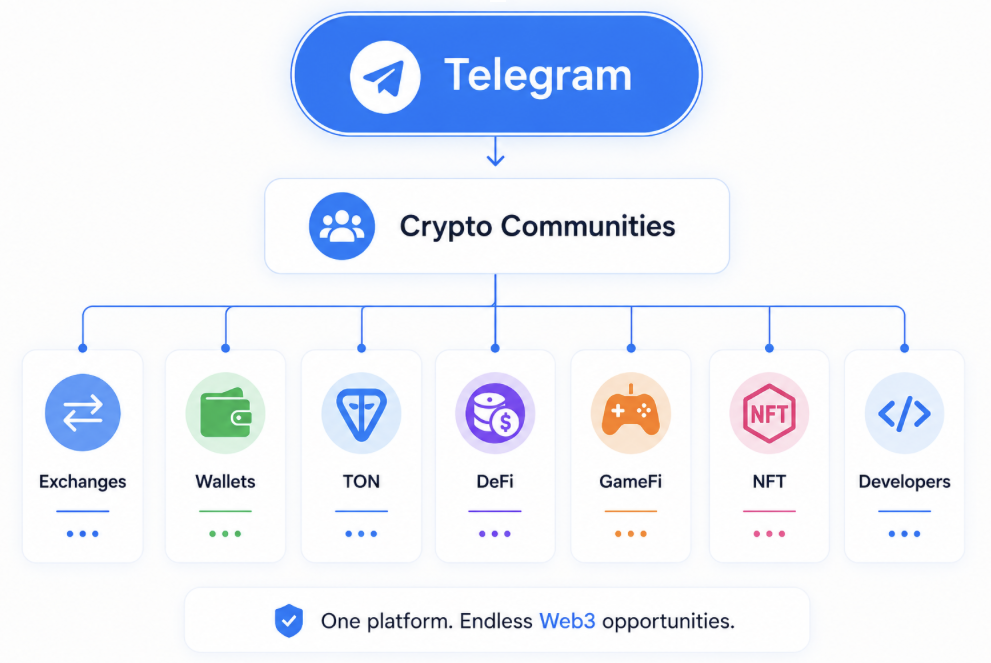
The main rule of Telegram moderation: it’s not the ads that are reviewed, but the user’s entire journey
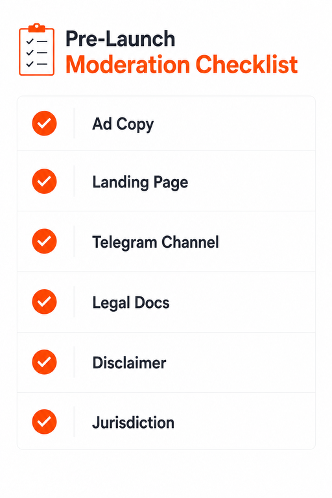
This is a point that many marketers underestimate. In practice, Telegram evaluates the entire chain of user interaction with an ad.
Specifically, it checks:
- the ad copy;
- the link the ad leads to;
- the Telegram channel;
- the bot, app, or Mini App;
- the landing page;
- the product description;
- legal information;
- financial promises;
- and whether the product complies with the requirements of a specific country.
This is where the main cause of most failures lies.
For example, the ad itself might look completely harmless: "Join our Web3 community and stay up to date on project news." But if, after clicking, the user lands on a page with promises like "Up to 300% APY" or "Hurry and buy the token before the price goes up," the likelihood of rejection increases sharply.
In other words, Telegram evaluates not the individual ad, but the entire user experience.
! Successful moderation starts not with the ad itself, but with preparing the entire advertising funnel.
Telegram Ads Policy for Crypto Projects
Projects that focus on technology, the product, or educational value tend to pass moderation most easily.
The product type itself does not guarantee rejection or approval. What matters much more is how it is presented.
Ad Formats and Targeting in Telegram Ads
Telegram Ads is significantly simpler than Meta or Google Ads Manager, which is both an advantage and a limitation.
Available formats:
- Sponsored Messages — short text ads (up to 160 characters, including the link) that appear in public channels with an audience of 1,000 or more subscribers.
- Text + Call-to-Action Button — the ad can link either to an external website or to another Telegram channel/bot, which is particularly convenient for crypto projects that often build their conversion funnel specifically through a Telegram bot (for example, to register for a presale or to access a private channel).
Unlike most advertising platforms, Telegram focuses not so much on the behavior of individual users as on context. This means that a campaign’s success largely depends on the communities in which the ads are seen.
Various targeting options are available for crypto projects:
- thematic channels;
- specific Telegram channels;
- audience language;
- geography;
- interest categories;
- Device type (iOS, Android, Desktop);
- specific bots (depending on the campaign scenario).
What works in practice? Placing ads directly on major crypto news channels and trading chat rooms almost always yields a better CTR than broad targeting within the "Crypto" category—because each major channel has its own specific audience (some focus more on DeFi, others on meme coins, and still others on macro market analysis). It makes sense to start with 5−10 specific channels that are relevant to your product, rather than relying on automatic category targeting.
For crypto companies, the key question shouldn’t be, "How can we reach the maximum number of users?" but rather, "In what context will users see our ads?"
For example:
- It makes sense to promote a crypto wallet alongside educational channels about Web3, security, and self-custody;
- a blockchain analytics service—in communities of developers and technical specialists;
- a TON ecosystem product—in channels dedicated to TON and Telegram Mini Apps;
- infrastructure solutions for businesses—in professional Web3 and FinTech communities.
Recommended Telegram Ads Targeting for Crypto Projects
In addition, the quality of the channel itself also affects how an advertising campaign is perceived. If a platform regularly publishes questionable content or makes aggressive investment promises, this can negatively impact both the effectiveness of the ads and the moderation process.
Need help launching Telegram Ads?
How to Prepare a Crypto Advertising Campaign Before Submitting It for Moderation
The best strategy is not to deal with rejections after launching an ad, but to prevent them before submitting the campaign for review.
1. Review the text of the ad
It is the advertising message that shapes the first impression of your project. It should be clear, specific, and neutral.
Avoid wording that promises financial gain or creates the impression of guaranteed earnings. For example, it’s best to avoid phrases such as:
- "Guaranteed profit";
- "Risk-free income";
- "Earn money every day";
- "Get rich with cryptocurrency";
- "x100 token";
- "Last chance to make money";
- "Safe investments";
- "Instant passive income."
Instead, emphasize the value of the product itself:
- ease of use;
- technology;
- security;
- transparency;
- educational content;
- research;
- community development;
- service functionality.
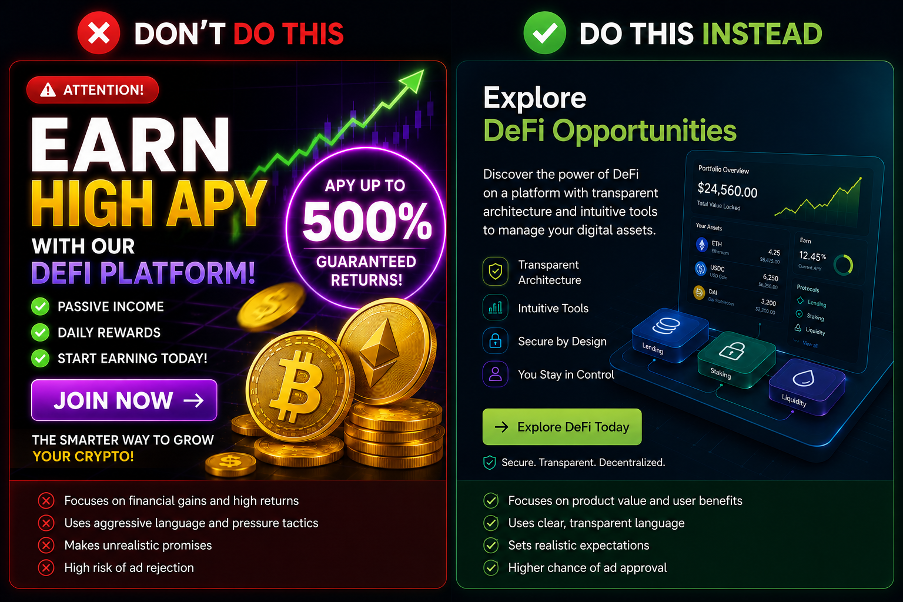
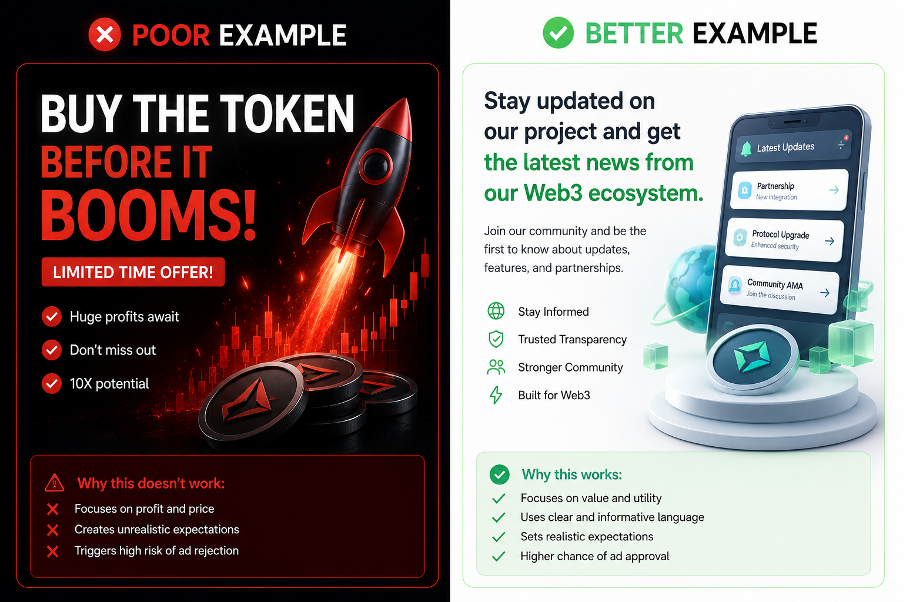
The difference may seem small, but it is precisely phrasing like this that often determines the outcome of moderation.
2. Check the landing page
Very often, the problem lies not with the ad itself, but with the page the user is directed to.
From a moderation perspective, the landing page is an extension of the ad. Therefore, it must look professional, be transparent, and match the content of the ad.
Ideally, the page should include:
- a clear description of the product;
- information about the company or project;
- a risk warning (if necessary);
- Terms of Use;
- Privacy Policy;
- contact information;
- no misleading financial promises;
- language consistency between the ad, landing page, and target audience (for example, Spanish for Mexico or Portuguese for Brazil).
- consistency with the ad’s message.
If, after clicking, a user lands on a page with aggressive investment slogans, a lack of legal information, or an unfinished design, the likelihood of bounce increases significantly.
3. Don't forget about the Telegram channel or bot
This is one of the most underrated stages of preparation.
If an ad leads to a Telegram channel, the moderation team will also evaluate its content.
Best practices include:
- pinning a post with a description of the project;
- introducing the team;
- explaining the product’s value;
- removing blatantly speculative posts;
- and making the channel resemble an official source of information rather than a platform promising quick money.
4. Add the necessary disclaimers
Cryptocurrency products always involve financial risks.
Attempting to conceal this fact usually raises more questions than openly warning users.
In many cases, a properly drafted disclaimer helps make a project more transparent and increase the level of trust on the part of moderators.
For example:
- Cryptocurrency assets involve a high level of risk.
- This material is for informational purposes only and does not constitute investment advice.
- The availability of this product depends on the laws of your country.
Of course, the specific wording depends on the product and the requirements of the jurisdiction, but the general principle remains the same: do not give the impression that investing in cryptocurrency is safe or guaranteed to be profitable.
5. Take into account the requirements of the specific country
When launching an ad campaign, many teams focus exclusively on Telegram’s rules.
But crypto advertising is regulated by more than just the platform itself.
Legislation can vary significantly from country to country.
Therefore, before launching a campaign, it’s important to answer a few questions:
- In which country is the project registered?
- In which countries will the ads be displayed?
- Are licenses required to promote the product?
- Is this type of crypto product permitted in the selected jurisdiction?
- Do you need to include additional legal disclaimers?
Even if Telegram approves the campaign, local legal requirements still apply.
The Most Common Reasons for Rejection During Moderation
Despite the wide variety of crypto projects, most failures occur for the same reasons.
When You Need Agency Support
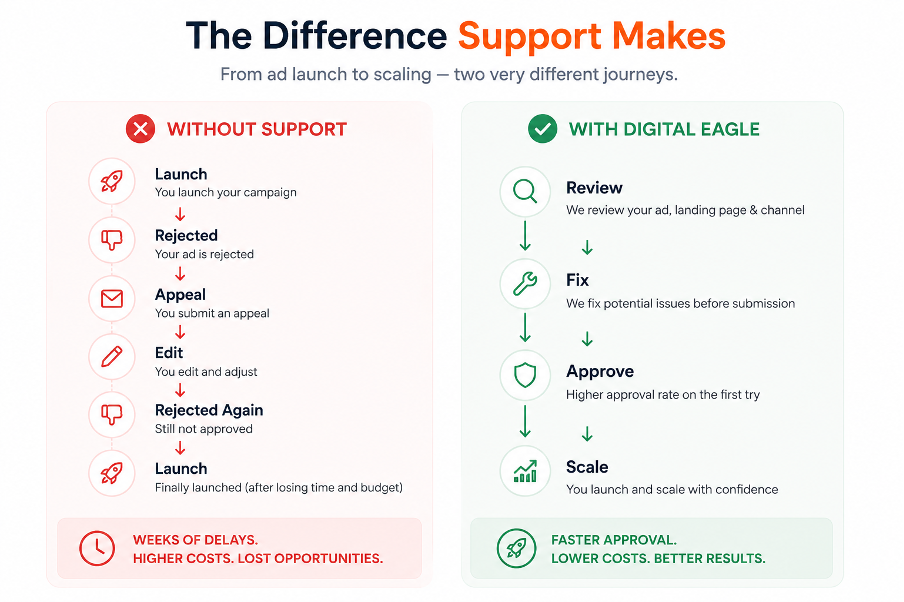
Most teams can conduct a test run on a small budget on their own—the format is simple, the interface is intuitive, and the rules described above cover most of the risks. However, as ad volume grows, several issues arise that are harder to manage on your own:
The number of rejections grows nonlinearly with scale. A single rejected ad can easily be rewritten and resubmitted. When a team tests 20−30 creative variations per week across multiple markets, manually tracking which ones were approved, which were rejected, and why becomes a full-fledged operational burden.
Lack of direct communication with moderation. Telegram Ads does not have a public escalation channel comparable to those offered by major advertising platforms. If an account is restricted without a clear explanation, an independent advertiser often simply has no channel to turn to for clarification—other than a general support form with unpredictable response times.
Compliance nuances change faster than the team can keep up with. Platform policies regarding financial advertising are not static documents; wording that passed moderation six months ago may be rejected today. Agencies that work with a large volume of crypto ads on an ongoing basis keep a close eye on these changes in near real time, unlike a team that runs Telegram Ads only once a quarter.
In these cases, agency support for moderation and compliance isn’t a luxury—it's a way to avoid wasting time and budget on predictable mistakes that an experienced team can spot right away.
Summary
Telegram remains one of the most accessible major platforms for crypto advertising precisely because it does not impose formal certification barriers, unlike Google or Meta. But that doesn’t mean content moderation is more lenient here—on the contrary, the lack of a clear, automated checklist makes moderators' decisions less predictable, and errors in copy, landing pages, and referral mechanics become more costly as the budget grows.
Teams that treat a Telegram Ads campaign launch as seriously as they would on any other platform—by verifying ad copy, landing page compliance, and jurisdictional requirements before launch, rather than after a rejection—typically pass moderation much faster and without wasting budget on rejected tests.
FAQ
What is the minimum budget required to launch Telegram Ads?
The minimum top-up for a Telegram Ads account is € 500. While this is enough to start running campaigns, the actual budget required depends on your targeting, CPMs, and campaign objectives. For larger niche channels and statistically meaningful tests, advertisers often allocate a higher budget.
Why was my staking ad rejected if it doesn’t promise a specific percentage?
Most often, the reason isn’t the number itself, but the wording. The words "guaranteed," "risk-free," and "no risk" trigger a rejection regardless of whether an exact percentage is specified—Telegram reacts to the very fact of a financial promise, not just its size.
Can Telegram Ads be targeted to specific countries?
Yes. Telegram Ads supports country-level targeting, but each country is served through a dedicated advertising account. This means advertisers typically use separate Telegram Ads accounts for different geographies rather than running multiple countries from a single account.
EUR-denominated Telegram Ads accounts are currently available for the following countries:
Brazil, United Arab Emirates, Qatar, Saudi Arabia, Turkey, India, Mexico, Indonesia, Argentina, Colombia, Chile, Peru, Kazakhstan, Belarus, Russian Federation, Uzbekistan, Azerbaijan, Armenia, Georgia, Tajikistan, Bangladesh, Israel, Malaysia, Pakistan, Philippines, Thailand, Vietnam, Egypt, Ethiopia, Morocco, and South Africa.
When planning international campaigns, it’s also important to ensure that your product complies with the regulatory requirements of each target country before launching ads.
How does advertising on Telegram differ from advertising in crypto channels directly through channel admins?
Sponsored Messages in Telegram Ads is the platform’s official advertising tool, featuring moderation and a standardized format. Direct placements through channel administrators (so-called "seed campaigns") are a separate, informal channel not moderated by Telegram, with its own risks (non-transparent metrics, inflated audience numbers) and opportunities (a more flexible format, native integration).
Does a product’s referral program affect the moderation process?
Yes, significantly. Referral mechanisms where payments to new users depend on their ability to recruit subsequent participants are interpreted by moderators as a sign of a pyramid scheme and are almost always rejected. If a product has a legitimate affiliate program, it’s safer to clearly describe it as a percentage of trading volume or activity, rather than as a reward for recruiting people.
Telegram is one of the main channels for reaching the Web3 audience: investors, traders, DAOs, DeFi and NFT communities, and thousands of niche channels.
Telegram doesn’t ban crypto ads, but launching them is harder than it looks. The platform’s moderation rules are only partly documented, and moderators review not just the ad but the whole user journey: the channel, bot, or landing page it leads to. Teams that miss this lose weeks to rejections and appeals instead of scaling.
In this guide, we break down how Telegram handles crypto ads in practice, which formats and targeting work, why most rejections are predictable, and when agency support makes sense.
Why Telegram Is One of the Main Marketing Channels for Crypto Projects
The Main Rule of Telegram Moderation: It's Not the Ad That's Reviewed, but the User's Entire Journey
Telegram Ads Policy for Crypto Projects
Ad Formats and Targeting in Telegram Ads
How to Prepare a Crypto Advertising Campaign Before Submitting It for Moderation
The Most Common Reasons for Rejection During Moderation
When You Need Agency Support
Summary
FAQ
The Main Rule of Telegram Moderation: It's Not the Ad That's Reviewed, but the User's Entire Journey
Telegram Ads Policy for Crypto Projects
Ad Formats and Targeting in Telegram Ads
How to Prepare a Crypto Advertising Campaign Before Submitting It for Moderation
The Most Common Reasons for Rejection During Moderation
When You Need Agency Support
Summary
FAQ
Why Telegram Is One of the Main Marketing Channels for Crypto Projects
Most advertising platforms consider cryptocurrency-related content to be high-risk. Telegram is no exception.
However, there is a fundamental difference between Telegram and platforms such as Meta, Google, or TikTok. Technically, Telegram Ads allows advertising for cryptocurrency products—this already sets the platform apart from Meta, where crypto advertising requires separate certification, and from Google, where strict geographic and licensing restrictions apply.
For Telegram, the crypto ecosystem has become a natural part of the platform. It is here that new Web3 communities emerge, Telegram Mini Apps are launched, token announcements are published, updates to blockchain protocols are discussed, and users of crypto wallets, exchanges, and DeFi projects interact. In essence, Telegram has long since become one of the main hubs of communication for the entire Web3 industry.
That is precisely why advertising on Telegram allows you to reach the most relevant audience—people who are already interested in cryptocurrencies and actively participate in the industry.
However, there are some nuances. Since hundreds of new projects appear on the platform every day, Telegram is forced to monitor fraud schemes, pyramid schemes, fake investment offers, and projects that could mislead users with particular care. Therefore, the moderation team evaluates more than just the ad itself.
The main rule of Telegram moderation: it’s not the ads that are reviewed, but the user’s entire journey
This is a point that many marketers underestimate. In practice, Telegram evaluates the entire chain of user interaction with an ad.
Specifically, it checks:
- the ad copy;
- the link the ad leads to;
- the Telegram channel;
- the bot, app, or Mini App;
- the landing page;
- the product description;
- legal information;
- financial promises;
- and whether the product complies with the requirements of a specific country.
This is where the main cause of most failures lies.
For example, the ad itself might look completely harmless: "Join our Web3 community and stay up to date on project news." But if, after clicking, the user lands on a page with promises like "Up to 300% APY" or "Hurry and buy the token before the price goes up," the likelihood of rejection increases sharply.
In other words, Telegram evaluates not the individual ad, but the entire user experience.
! Successful moderation starts not with the ad itself, but with preparing the entire advertising funnel.
Telegram Ads Policy for Crypto Projects
Projects that focus on technology, the product, or educational value tend to pass moderation most easily.
The product type itself does not guarantee rejection or approval. What matters much more is how it is presented.
Ad Formats and Targeting in Telegram Ads
Telegram Ads is significantly simpler than Meta or Google Ads Manager, which is both an advantage and a limitation.
Available formats:
- Sponsored Messages — short text ads (up to 160 characters, including the link) that appear in public channels with an audience of 1,000 or more subscribers.
- Text + Call-to-Action Button — the ad can link either to an external website or to another Telegram channel/bot, which is particularly convenient for crypto projects that often build their conversion funnel specifically through a Telegram bot (for example, to register for a presale or to access a private channel).
Unlike most advertising platforms, Telegram focuses not so much on the behavior of individual users as on context. This means that a campaign’s success largely depends on the communities in which the ads are seen.
Various targeting options are available for crypto projects:
- thematic channels;
- specific Telegram channels;
- audience language;
- geography;
- interest categories;
- Device type (iOS, Android, Desktop);
- specific bots (depending on the campaign scenario).
What works in practice? Placing ads directly on major crypto news channels and trading chat rooms almost always yields a better CTR than broad targeting within the "Crypto" category—because each major channel has its own specific audience (some focus more on DeFi, others on meme coins, and still others on macro market analysis). It makes sense to start with 5−10 specific channels that are relevant to your product, rather than relying on automatic category targeting.
For crypto companies, the key question shouldn’t be, "How can we reach the maximum number of users?" but rather, "In what context will users see our ads?"
For example:
- It makes sense to promote a crypto wallet alongside educational channels about Web3, security, and self-custody;
- a blockchain analytics service—in communities of developers and technical specialists;
- a TON ecosystem product—in channels dedicated to TON and Telegram Mini Apps;
- infrastructure solutions for businesses—in professional Web3 and FinTech communities.
Recommended Telegram Ads Targeting for Crypto Projects
In addition, the quality of the channel itself also affects how an advertising campaign is perceived. If a platform regularly publishes questionable content or makes aggressive investment promises, this can negatively impact both the effectiveness of the ads and the moderation process.
Need help launching Telegram Ads?
How to Prepare a Crypto Advertising Campaign Before Submitting It for Moderation
The best strategy is not to deal with rejections after launching an ad, but to prevent them before submitting the campaign for review.
1. Review the text of the ad
It is the advertising message that shapes the first impression of your project. It should be clear, specific, and neutral.
Avoid wording that promises financial gain or creates the impression of guaranteed earnings. For example, it’s best to avoid phrases such as:
- "Guaranteed profit";
- "Risk-free income";
- "Earn money every day";
- "Get rich with cryptocurrency";
- "x100 token";
- "Last chance to make money";
- "Safe investments";
- "Instant passive income."
Instead, emphasize the value of the product itself:
- ease of use;
- technology;
- security;
- transparency;
- educational content;
- research;
- community development;
- service functionality.
The difference may seem small, but it is precisely phrasing like this that often determines the outcome of moderation.
2. Check the landing page
Very often, the problem lies not with the ad itself, but with the page the user is directed to.
From a moderation perspective, the landing page is an extension of the ad. Therefore, it must look professional, be transparent, and match the content of the ad.
Ideally, the page should include:
- a clear description of the product;
- information about the company or project;
- a risk warning (if necessary);
- Terms of Use;
- Privacy Policy;
- contact information;
- no misleading financial promises;
- language consistency between the ad, landing page, and target audience (for example, Spanish for Mexico or Portuguese for Brazil).
- consistency with the ad’s message.
If, after clicking, a user lands on a page with aggressive investment slogans, a lack of legal information, or an unfinished design, the likelihood of bounce increases significantly.
3. Don't forget about the Telegram channel or bot
This is one of the most underrated stages of preparation.
If an ad leads to a Telegram channel, the moderation team will also evaluate its content.
Best practices include:
- pinning a post with a description of the project;
- introducing the team;
- explaining the product’s value;
- removing blatantly speculative posts;
- and making the channel resemble an official source of information rather than a platform promising quick money.
4. Add the necessary disclaimers
Cryptocurrency products always involve financial risks.
Attempting to conceal this fact usually raises more questions than openly warning users.
In many cases, a properly drafted disclaimer helps make a project more transparent and increase the level of trust on the part of moderators.
For example:
- Cryptocurrency assets involve a high level of risk.
- This material is for informational purposes only and does not constitute investment advice.
- The availability of this product depends on the laws of your country.
Of course, the specific wording depends on the product and the requirements of the jurisdiction, but the general principle remains the same: do not give the impression that investing in cryptocurrency is safe or guaranteed to be profitable.
5. Take into account the requirements of the specific country
When launching an ad campaign, many teams focus exclusively on Telegram’s rules.
But crypto advertising is regulated by more than just the platform itself.
Legislation can vary significantly from country to country.
Therefore, before launching a campaign, it’s important to answer a few questions:
- In which country is the project registered?
- In which countries will the ads be displayed?
- Are licenses required to promote the product?
- Is this type of crypto product permitted in the selected jurisdiction?
- Do you need to include additional legal disclaimers?
Even if Telegram approves the campaign, local legal requirements still apply.
The Most Common Reasons for Rejection During Moderation
Despite the wide variety of crypto projects, most failures occur for the same reasons.
When You Need Agency Support
Most teams can conduct a test run on a small budget on their own—the format is simple, the interface is intuitive, and the rules described above cover most of the risks. However, as ad volume grows, several issues arise that are harder to manage on your own:
The number of rejections grows nonlinearly with scale. A single rejected ad can easily be rewritten and resubmitted. When a team tests 20−30 creative variations per week across multiple markets, manually tracking which ones were approved, which were rejected, and why becomes a full-fledged operational burden.
Lack of direct communication with moderation. Telegram Ads does not have a public escalation channel comparable to those offered by major advertising platforms. If an account is restricted without a clear explanation, an independent advertiser often simply has no channel to turn to for clarification—other than a general support form with unpredictable response times.
Compliance nuances change faster than the team can keep up with. Platform policies regarding financial advertising are not static documents; wording that passed moderation six months ago may be rejected today. Agencies that work with a large volume of crypto ads on an ongoing basis keep a close eye on these changes in near real time, unlike a team that runs Telegram Ads only once a quarter.
In these cases, agency support for moderation and compliance isn’t a luxury—it's a way to avoid wasting time and budget on predictable mistakes that an experienced team can spot right away.
Summary
Telegram remains one of the most accessible major platforms for crypto advertising precisely because it does not impose formal certification barriers, unlike Google or Meta. But that doesn’t mean content moderation is more lenient here—on the contrary, the lack of a clear, automated checklist makes moderators' decisions less predictable, and errors in copy, landing pages, and referral mechanics become more costly as the budget grows.
Teams that treat a Telegram Ads campaign launch as seriously as they would on any other platform—by verifying ad copy, landing page compliance, and jurisdictional requirements before launch, rather than after a rejection—typically pass moderation much faster and without wasting budget on rejected tests.
FAQ
What is the minimum budget required to launch Telegram Ads?
The minimum top-up for a Telegram Ads account is € 500. While this is enough to start running campaigns, the actual budget required depends on your targeting, CPMs, and campaign objectives. For larger niche channels and statistically meaningful tests, advertisers often allocate a higher budget.
Why was my staking ad rejected if it doesn’t promise a specific percentage?
Most often, the reason isn’t the number itself, but the wording. The words "guaranteed," "risk-free," and "no risk" trigger a rejection regardless of whether an exact percentage is specified—Telegram reacts to the very fact of a financial promise, not just its size.
Can Telegram Ads be targeted to specific countries?
Yes. Telegram Ads supports country-level targeting, but each country is served through a dedicated advertising account. This means advertisers typically use separate Telegram Ads accounts for different geographies rather than running multiple countries from a single account.
EUR-denominated Telegram Ads accounts are currently available for the following countries:
Brazil, United Arab Emirates, Qatar, Saudi Arabia, Turkey, India, Mexico, Indonesia, Argentina, Colombia, Chile, Peru, Kazakhstan, Belarus, Russian Federation, Uzbekistan, Azerbaijan, Armenia, Georgia, Tajikistan, Bangladesh, Israel, Malaysia, Pakistan, Philippines, Thailand, Vietnam, Egypt, Ethiopia, Morocco, and South Africa.
When planning international campaigns, it’s also important to ensure that your product complies with the regulatory requirements of each target country before launching ads.
How does advertising on Telegram differ from advertising in crypto channels directly through channel admins?
Sponsored Messages in Telegram Ads is the platform’s official advertising tool, featuring moderation and a standardized format. Direct placements through channel administrators (so-called "seed campaigns") are a separate, informal channel not moderated by Telegram, with its own risks (non-transparent metrics, inflated audience numbers) and opportunities (a more flexible format, native integration).
Does a product’s referral program affect the moderation process?
Yes, significantly. Referral mechanisms where payments to new users depend on their ability to recruit subsequent participants are interpreted by moderators as a sign of a pyramid scheme and are almost always rejected. If a product has a legitimate affiliate program, it’s safer to clearly describe it as a percentage of trading volume or activity, rather than as a reward for recruiting people.
You might also like...