


How to Choose a UA Financing Partner in 2026
Learn how to choose the right UA financing partner in 2026. Compare funding models, evaluate credit lines and scale user acquisition without diluting equity.

User Acquisition
07.04.2026
Get weekly ad updates. No spam

Sooner or later, growing mobile or digital businesses face the same challenge: cashflow. Campaigns are working, the unit economics make sense, but the gap between spends and revenue becomes a bottleneck.
That’s exactly why UA financing (User Acquisition Financing) is becoming an increasingly important tool for subscription apps, gaming companies, fintech products, web businesses, and other digital companies.
However, not all financing solutions are equally well-suited for user acquisition.
In this article, we’ll explore the factors to consider when choosing a UA financing partner in 2026.
That’s exactly why UA financing (User Acquisition Financing) is becoming an increasingly important tool for subscription apps, gaming companies, fintech products, web businesses, and other digital companies.
However, not all financing solutions are equally well-suited for user acquisition.
In this article, we’ll explore the factors to consider when choosing a UA financing partner in 2026.
Why UA Financing Exists as a Category
The Financing Landscape: Where Different Models Fit
Illustrative Example
What Questions Should You Ask a Potential Partner?
A Real Example of Scaling
What Actually Matters Before Raising Growth Capital
FAQ
The Financing Landscape: Where Different Models Fit
Illustrative Example
What Questions Should You Ask a Potential Partner?
A Real Example of Scaling
What Actually Matters Before Raising Growth Capital
FAQ
Why UA Financing Exists as a Category
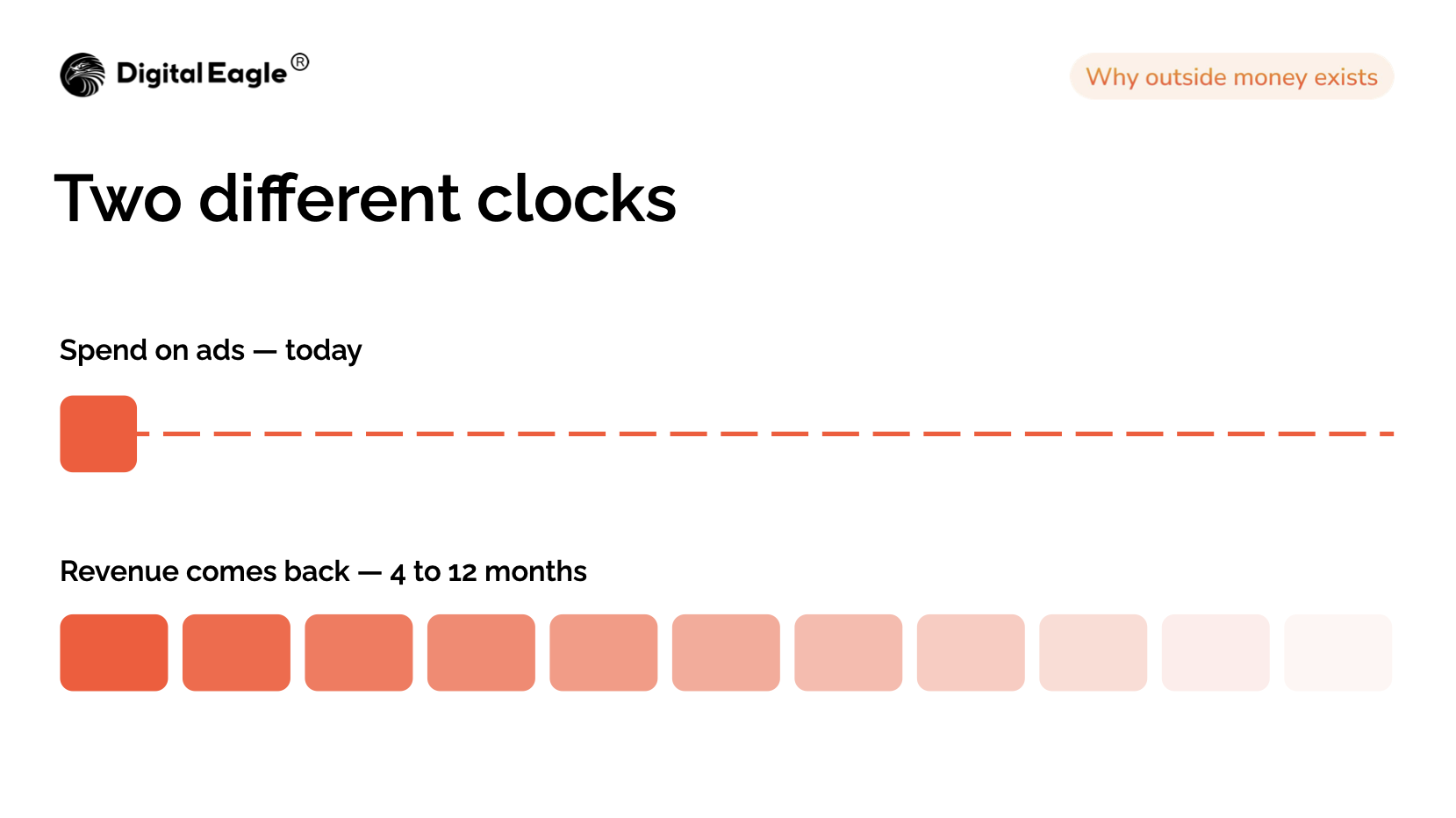
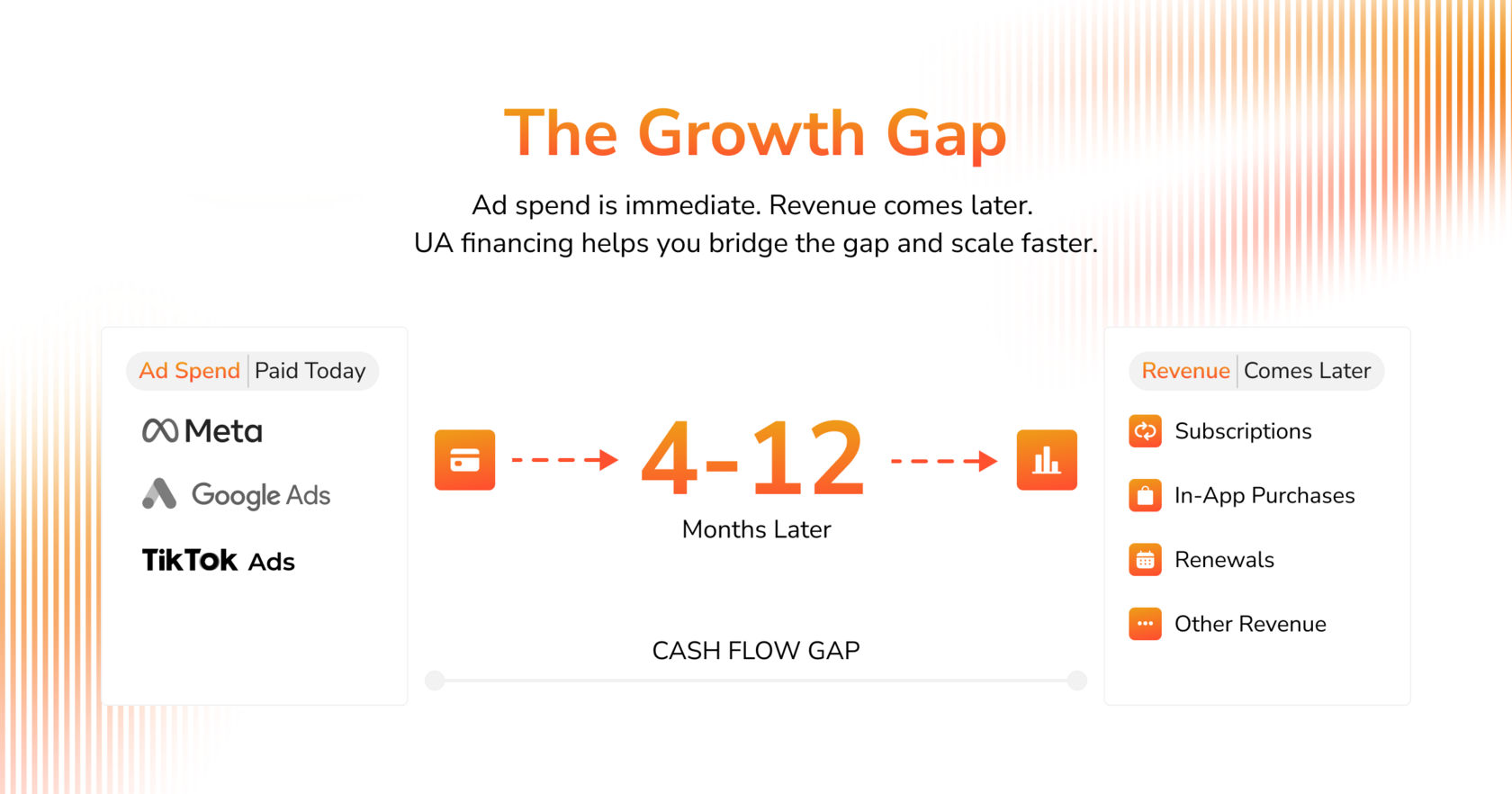
For many mobile apps, the user payback period ranges from 4 to 12 months, depending on the product, geography, monetization model, and user retention metrics.
As a result, a typical situation arises:
For most companies in the growth stage, this is the biggest constraint on their ability to scale.
That is precisely why structured advertising financing — credit lines, revenue-based financing, and factoring — has evolved over the past few years into a distinct category of lending, separate from traditional venture capital or bank loans. This is not a substitute for raising capital. It is a tool that solves a specific, recurring cash flow problem: bridging the temporary gap between expenses and revenue without diluting shareholder equity or waiting for a decision from the board of directors.
As a result, a typical situation arises:
- ad campaigns are profitable;
- there is potential for scaling;
- but the amount of available cash limits growth.
For most companies in the growth stage, this is the biggest constraint on their ability to scale.
That is precisely why structured advertising financing — credit lines, revenue-based financing, and factoring — has evolved over the past few years into a distinct category of lending, separate from traditional venture capital or bank loans. This is not a substitute for raising capital. It is a tool that solves a specific, recurring cash flow problem: bridging the temporary gap between expenses and revenue without diluting shareholder equity or waiting for a decision from the board of directors.
The Financing Landscape: Where Different Models Fit
Many company founders compare financing options based solely on the interest rate. In practice, this often turns out to be a mistake.
It is much more important to understand how well the financing structure itself aligns with the specifics of performance marketing.
Let’s take a look at the main options.
It is much more important to understand how well the financing structure itself aligns with the specifics of performance marketing.
Let’s take a look at the main options.
Venture Capital (Equity Financing)
Raising investment allows a company to secure a significant amount of capital, but it is usually a lengthy process. It is valuable for long-term strategic financing, but the process—including the presentation, due diligence, negotiations on terms, and board approval—can take months. It is also ill-suited for something as recurring and operational as daily advertising expenses; using equity to finance a campaign that pays for itself in 90 days is rarely the most effective use of dilutive capital.
Bank Loans
Traditional loans may offer relatively low interest rates, but they are often difficult for early-stage companies to access. Banks typically require collateral, established credit history, audited financial statements, and predictable cash flows—criteria that many young digital businesses have not yet met.
Factoring
Factoring unlocks cash tied up in outstanding invoices, but it doesn’t create additional growth capital. Because funding is based on revenue you’ve already generated, it may not be sufficient to finance the next stage of scaling.
Revenue-Based Financing
This model provides upfront capital in exchange for a percentage of the company’s future revenue until a predetermined repayment amount is reached. While repayments adjust to business performance, higher revenue also means higher repayments, leaving less cash available to reinvest in user acquisition and growth.
Structured Credit Lines
Credit lines come in many forms. Traditional business credit lines typically provide access to a fixed borrowing limit and often require a predefined repayment schedule, regardless of how quickly the borrowed funds generate returns.
A revolving credit line offers greater flexibility. Businesses can draw funds as needed, repay them at their own pace, and regain access to the available credit as repayments are made. Interest is charged only on the outstanding balance rather than the total approved limit. This means financing costs decrease when you repay faster, while the replenished credit line remains available to fund your next growth cycle.
This is the model Digital Eagle uses for its UA Financing program. By offering a revolving credit line tailored to digital businesses, we help companies finance user acquisition with flexible access to growth capital rather than one-time funding.
Illustrative Example (Not Real Pricing)
The example below is for illustration only and does not represent actual financing terms. Every credit line is tailored to a company’s performance, cash flow, and repayment profile. If you’d like to estimate your own financing terms, get in touch with our team for a personalized assessment.
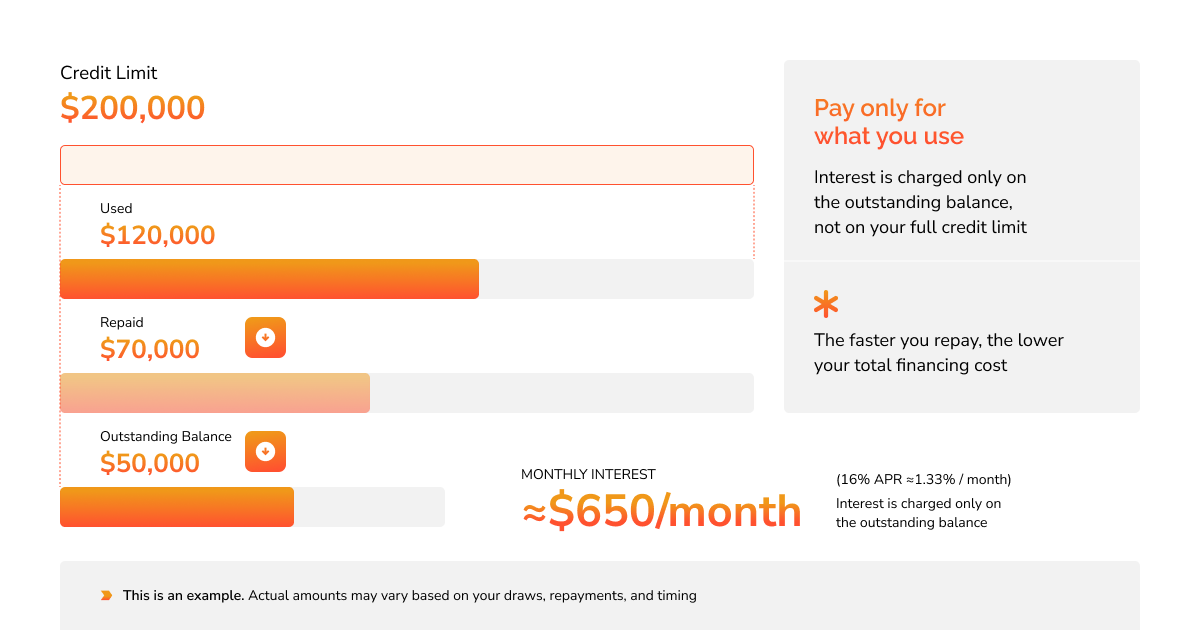
Imagine your business has access to a $ 200,000 revolving credit line with a 16% annual interest rate (approximately 1.33% per month).
The key point is that interest is not charged on the full $ 200,000 credit limit.
Instead, interest is charged only on the outstanding balance — the amount you have actually borrowed and not yet repaid.
For example:
- Credit line: $ 200,000
- Amount used: $ 120,000
- Amount repaid: $ 70,000
- Outstanding balance: $ 50,000
Once you repay the $ 70,000, interest immediately stops accruing on that portion of the debt.
From that point forward, you continue paying 16% annually (approximately 1.33% per month) only on the remaining $ 50,000 outstanding balance — around $ 650 per month while those funds remain in use.
The faster you repay the borrowed funds, the lower your total financing cost.
You’re not paying for the entire credit line — you’re paying only for the capital you actually use, and only for as long as you use it.
What Questions Should You Ask a Potential Partner?
Before signing anything, it’s worth taking a close look at:
- How interest is structured. Is it charged on the entire loan amount or only on the amount actually used? A revolving line of credit, where interest is charged only on the outstanding balance, behaves completely differently from a line where the full limit is drawn down from day one.
- What the repayment schedule looks like. Is it a flexible structure tied to your ROAS cycle, or a fixed schedule that doesn’t change if a campaign underperforms in a given month?
- Any additional fees. Infrastructure or service fees on top of the base rate can vary significantly depending on the industry, account history, and the level of support required.
- What happens if you can’t repay the loan on time? This is a point that most teams overlook, but it’s the most critical if the quarter doesn’t go as planned.
- Early repayment options. Some structures impose a penalty for early repayment, while others offer an incentive. Since the cost is typically tied to how long the balance remains outstanding, the ability to repay early without a penalty can significantly alter the total cost of capital.
About Deployment Speed:
- How long does it take from approval to the actual use of funds in an advertising account?
- What happens if a campaign requires an unplanned top-up in the middle of the cycle?
A Real Example of Scaling
Not all UA financing providers limit themselves to providing access to capital. Some also help address operational challenges related to launching and scaling advertising campaigns—from payments to advertising infrastructure.
For example, the Lovon app used a structured credit line to scale its existing campaigns without raising additional capital or diluting equity. Over the next six months, advertising budgets more than doubled, while ARR and MRR grew nearly fivefold.
You can read more about this case study here: How Lovon App Scaled with Digital Eagle
What Actually Matters Before Raising Growth Capital
Any financing model can be effective. Whether it’s a traditional bank loan, factoring, Revenue-Based Financing, or a revolving credit line, each has its place when aligned with your business model and stage of growth.
In practice, success depends less on where the capital comes from and more on how well you understand the economics of your own business.
Before raising external capital, ask yourself a few important questions:
- Do you truly understand and control your unit economics?
- Do you have a clear scaling strategy and know exactly how additional capital will be deployed?
- Which financing options are actually available to your business today?
- What is the true cost of that capital—not just the interest rate, but also the repayment structure, operational constraints, and overall impact on cash flow?
Ultimately, external capital doesn’t solve business problems on its own—it amplifies what’s already there. If your business fundamentals are strong, financing can help you scale faster. If they aren’t, additional capital may simply accelerate inefficient spending.
The goal isn’t just to secure funding. It’s to choose a financing model that supports sustainable growth rather than creating new constraints.
FAQ
What is UA financing?
UA (User Acquisition) financing is capital specifically structured to fund advertising spend — bridging the gap between when ad costs are paid and when the resulting revenue actually comes in. It typically takes the form of a credit line, revenue-based financing, or factoring, rather than traditional equity or bank debt.
Is UA financing only for mobile apps?
No. While it’s especially common among subscription apps and mobile games due to their predictable payback cycles, the same structures apply to gaming companies, fintech products, SaaS businesses, and other digital companies that scale primarily through paid acquisition.
Why does deployment speed matter as much as the interest rate?
Advertising platforms reward consistent, scaled spend with better placement, more data, and sharper optimization. A delay of even a few weeks in accessing capital can mean lost momentum, resetting algorithmic learning, and ceding ground to competitors who keep spending. In some cases, slightly more expensive capital available in days is more valuable than cheaper capital that takes months to access.
Why does ad infrastructure matter as much as the financing itself?
Capital that arrives on time but lands in an account that gets frozen, restricted, or flagged for fraud doesn’t solve the underlying problem. A financing partner that also manages payment processing, pre-launch compliance review, and fast escalation when accounts get restricted closes the gap between having capital and actually being able to spend it.
How quickly can UA financing be deployed?
The timeline varies by provider. Some solutions may take weeks or months to arrange, while others are designed to provide access to capital within days.
Sooner or later, growing mobile or digital businesses face the same challenge: cashflow. Campaigns are working, the unit economics make sense, but the gap between spends and revenue becomes a bottleneck.
That’s exactly why UA financing (User Acquisition Financing) is becoming an increasingly important tool for subscription apps, gaming companies, fintech products, web businesses, and other digital companies.
However, not all financing solutions are equally well-suited for user acquisition.
In this article, we’ll explore the factors to consider when choosing a UA financing partner in 2026.
That’s exactly why UA financing (User Acquisition Financing) is becoming an increasingly important tool for subscription apps, gaming companies, fintech products, web businesses, and other digital companies.
However, not all financing solutions are equally well-suited for user acquisition.
In this article, we’ll explore the factors to consider when choosing a UA financing partner in 2026.
Why UA Financing Exists as a Category
The Financing Landscape: Where Different Models Fit
Illustrative Example
What Questions Should You Ask a Potential Partner?
A Real Example of Scaling
What Actually Matters Before Raising Growth Capital
FAQ
The Financing Landscape: Where Different Models Fit
Illustrative Example
What Questions Should You Ask a Potential Partner?
A Real Example of Scaling
What Actually Matters Before Raising Growth Capital
FAQ
Why UA Financing Exists as a Category
For many mobile apps, the user payback period ranges from 4 to 12 months, depending on the product, geography, monetization model, and user retention metrics.
As a result, a typical situation arises:
For most companies in the growth stage, this is the biggest constraint on their ability to scale.
That is precisely why structured advertising financing — credit lines, revenue-based financing, and factoring — has evolved over the past few years into a distinct category of lending, separate from traditional venture capital or bank loans. This is not a substitute for raising capital. It is a tool that solves a specific, recurring cash flow problem: bridging the temporary gap between expenses and revenue without diluting shareholder equity or waiting for a decision from the board of directors.
As a result, a typical situation arises:
- ad campaigns are profitable;
- there is potential for scaling;
- but the amount of available cash limits growth.
For most companies in the growth stage, this is the biggest constraint on their ability to scale.
That is precisely why structured advertising financing — credit lines, revenue-based financing, and factoring — has evolved over the past few years into a distinct category of lending, separate from traditional venture capital or bank loans. This is not a substitute for raising capital. It is a tool that solves a specific, recurring cash flow problem: bridging the temporary gap between expenses and revenue without diluting shareholder equity or waiting for a decision from the board of directors.
The Financing Landscape: Where Different Models Fit
Many company founders compare financing options based solely on the interest rate. In practice, this often turns out to be a mistake.
It is much more important to understand how well the financing structure itself aligns with the specifics of performance marketing.
Let’s take a look at the main options.
It is much more important to understand how well the financing structure itself aligns with the specifics of performance marketing.
Let’s take a look at the main options.
Venture Capital (Equity Financing)
Raising investment allows a company to secure a significant amount of capital, but it is usually a lengthy process. It is valuable for long-term strategic financing, but the process—including the presentation, due diligence, negotiations on terms, and board approval—can take months. It is also ill-suited for something as recurring and operational as daily advertising expenses; using equity to finance a campaign that pays for itself in 90 days is rarely the most effective use of dilutive capital.
Bank Loans
Traditional loans may offer relatively low interest rates, but they are often difficult for early-stage companies to access. Banks typically require collateral, established credit history, audited financial statements, and predictable cash flows—criteria that many young digital businesses have not yet met.
Factoring
Factoring unlocks cash tied up in outstanding invoices, but it doesn’t create additional growth capital. Because funding is based on revenue you’ve already generated, it may not be sufficient to finance the next stage of scaling.
Revenue-Based Financing
This model provides upfront capital in exchange for a percentage of the company’s future revenue until a predetermined repayment amount is reached. While repayments adjust to business performance, higher revenue also means higher repayments, leaving less cash available to reinvest in user acquisition and growth.
Structured Credit Lines
Credit lines come in many forms. Traditional business credit lines typically provide access to a fixed borrowing limit and often require a predefined repayment schedule, regardless of how quickly the borrowed funds generate returns.
A revolving credit line offers greater flexibility. Businesses can draw funds as needed, repay them at their own pace, and regain access to the available credit as repayments are made. Interest is charged only on the outstanding balance rather than the total approved limit. This means financing costs decrease when you repay faster, while the replenished credit line remains available to fund your next growth cycle.
This is the model Digital Eagle uses for its UA Financing program. By offering a revolving credit line tailored to digital businesses, we help companies finance user acquisition with flexible access to growth capital rather than one-time funding.
Illustrative Example (Not Real Pricing)
The example below is for illustration only and does not represent actual financing terms. Every credit line is tailored to a company’s performance, cash flow, and repayment profile. If you’d like to estimate your own financing terms, get in touch with our team for a personalized assessment.
Imagine your business has access to a $ 200,000 revolving credit line with a 16% annual interest rate (approximately 1.33% per month).
The key point is that interest is not charged on the full $ 200,000 credit limit.
Instead, interest is charged only on the outstanding balance — the amount you have actually borrowed and not yet repaid.
For example:
- Credit line: $ 200,000
- Amount used: $ 120,000
- Amount repaid: $ 70,000
- Outstanding balance: $ 50,000
Once you repay the $ 70,000, interest immediately stops accruing on that portion of the debt.
From that point forward, you continue paying 16% annually (approximately 1.33% per month) only on the remaining $ 50,000 outstanding balance — around $ 650 per month while those funds remain in use.
The faster you repay the borrowed funds, the lower your total financing cost.
You’re not paying for the entire credit line — you’re paying only for the capital you actually use, and only for as long as you use it.
What Questions Should You Ask a Potential Partner?
Before signing anything, it’s worth taking a close look at:
- How interest is structured. Is it charged on the entire loan amount or only on the amount actually used? A revolving line of credit, where interest is charged only on the outstanding balance, behaves completely differently from a line where the full limit is drawn down from day one.
- What the repayment schedule looks like. Is it a flexible structure tied to your ROAS cycle, or a fixed schedule that doesn’t change if a campaign underperforms in a given month?
- Any additional fees. Infrastructure or service fees on top of the base rate can vary significantly depending on the industry, account history, and the level of support required.
- What happens if you can’t repay the loan on time? This is a point that most teams overlook, but it’s the most critical if the quarter doesn’t go as planned.
- Early repayment options. Some structures impose a penalty for early repayment, while others offer an incentive. Since the cost is typically tied to how long the balance remains outstanding, the ability to repay early without a penalty can significantly alter the total cost of capital.
About Deployment Speed:
- How long does it take from approval to the actual use of funds in an advertising account?
- What happens if a campaign requires an unplanned top-up in the middle of the cycle?
A Real Example of Scaling
Not all UA financing providers limit themselves to providing access to capital. Some also help address operational challenges related to launching and scaling advertising campaigns—from payments to advertising infrastructure.
For example, the Lovon app used a structured credit line to scale its existing campaigns without raising additional capital or diluting equity. Over the next six months, advertising budgets more than doubled, while ARR and MRR grew nearly fivefold.
You can read more about this case study here: How Lovon App Scaled with Digital Eagle
What Actually Matters Before Raising Growth Capital
Any financing model can be effective. Whether it’s a traditional bank loan, factoring, Revenue-Based Financing, or a revolving credit line, each has its place when aligned with your business model and stage of growth.
In practice, success depends less on where the capital comes from and more on how well you understand the economics of your own business.
Before raising external capital, ask yourself a few important questions:
- Do you truly understand and control your unit economics?
- Do you have a clear scaling strategy and know exactly how additional capital will be deployed?
- Which financing options are actually available to your business today?
- What is the true cost of that capital—not just the interest rate, but also the repayment structure, operational constraints, and overall impact on cash flow?
Ultimately, external capital doesn’t solve business problems on its own—it amplifies what’s already there. If your business fundamentals are strong, financing can help you scale faster. If they aren’t, additional capital may simply accelerate inefficient spending.
The goal isn’t just to secure funding. It’s to choose a financing model that supports sustainable growth rather than creating new constraints.
FAQ
What is UA financing?
UA (User Acquisition) financing is capital specifically structured to fund advertising spend — bridging the gap between when ad costs are paid and when the resulting revenue actually comes in. It typically takes the form of a credit line, revenue-based financing, or factoring, rather than traditional equity or bank debt.
Is UA financing only for mobile apps?
No. While it’s especially common among subscription apps and mobile games due to their predictable payback cycles, the same structures apply to gaming companies, fintech products, SaaS businesses, and other digital companies that scale primarily through paid acquisition.
Why does deployment speed matter as much as the interest rate?
Advertising platforms reward consistent, scaled spend with better placement, more data, and sharper optimization. A delay of even a few weeks in accessing capital can mean lost momentum, resetting algorithmic learning, and ceding ground to competitors who keep spending. In some cases, slightly more expensive capital available in days is more valuable than cheaper capital that takes months to access.
Why does ad infrastructure matter as much as the financing itself?
Capital that arrives on time but lands in an account that gets frozen, restricted, or flagged for fraud doesn’t solve the underlying problem. A financing partner that also manages payment processing, pre-launch compliance review, and fast escalation when accounts get restricted closes the gap between having capital and actually being able to spend it.
How quickly can UA financing be deployed?
The timeline varies by provider. Some solutions may take weeks or months to arrange, while others are designed to provide access to capital within days.
You might also like...